


Why Your Ecommerce Website Audit Strategy Matters Now

In the competitive ecommerce world, attractive products and compelling marketing aren't enough. You also need a deep understanding of your website's performance and how well it converts visitors into loyal customers. This is where an ecommerce website audit strategy comes in. It's like a regular health check-up for your online store, making sure everything is running smoothly.
The Connection Between Audits and Growth
Leading ecommerce brands know that regular audits aren't just maintenance; they're strategic investments. These audits can reveal hidden revenue leaks, improve customer satisfaction, and help maintain a competitive edge.
For example, a slow website can frustrate customers and lead to abandoned carts. Similarly, poor website navigation can make it hard for potential customers to find what they're looking for, sending them straight to your competitors.
Regular website audits help identify and fix these issues before they hurt your bottom line. They allow businesses to be proactive, optimize performance, and seize growth opportunities. Successful ecommerce stores see audits as essential to their success, just like inventory management and marketing campaigns.
The Importance of a Proactive Approach
Ecommerce website audits are becoming even more critical as the online marketplace grows. In 2023, global ecommerce sales reached an estimated $5.8 trillion. Projections show this rising to $6.42 trillion by 2025, a 6.86% year-over-year increase. This rapid growth highlights the need for online stores to maintain top performance.
Audits are key for assessing marketing effectiveness, evaluating ad metrics, and optimizing performance across different channels. Find more detailed statistics here
Building a Sustainable Audit Strategy
Effective ecommerce website audits cover several key areas:
-
Technical Performance: This includes checking website speed, mobile responsiveness, and the overall site architecture. A fast-loading, mobile-friendly website is essential for a good user experience and better search engine rankings.
-
User Experience (UX): A positive user experience is vital for turning visitors into customers. Audits look at website navigation, design clarity, and overall usability to create a smooth shopping experience.
-
Conversion Rate Optimization (CRO): This focuses on finding and fixing anything that prevents customers from completing a purchase. A thorough audit examines the checkout process, product pages, and other key elements to optimize the sales funnel.
-
SEO and Marketing Performance: Audits assess keyword optimization, content quality, and backlink profiles to ensure your website attracts the right organic traffic. This includes analyzing your marketing funnel and identifying untapped growth potential.
-
Security and Compliance: Protecting customer data is crucial. Audits examine security protocols, data protection measures, and compliance with regulations to build trust and ensure you're following the rules.
By regularly auditing your website and focusing on these areas, ecommerce businesses can not only survive but thrive in the dynamic world of online retail. A well-executed audit strategy provides the insights and actionable steps needed to improve website performance, make customers happier, and ultimately, drive significant revenue growth.
Breaking Down Your Complete Ecommerce Website Audit
An effective ecommerce website audit isn't a one-size-fits-all process. It needs a structured approach that aligns with your specific business goals and current performance. This section explains the essential parts of a comprehensive audit, going beyond the surface to examine the core elements that drive online success.
Key Components of an Effective Audit
A thorough ecommerce website audit covers several key areas. Each area contributes to the overall health and performance of your online store.
-
Technical Performance Evaluation: This looks at factors like site speed, mobile responsiveness, and overall website architecture. A fast, user-friendly site is important for both customer satisfaction and search engine rankings.
-
User Experience Assessment: This focuses on how easily customers can navigate your site, find products, and make purchases. A positive user experience turns visitors into loyal customers.
-
Conversion Optimization Analysis: This step identifies and removes obstacles that prevent customers from completing a purchase. It includes analyzing the checkout process, product page design, and other key elements.
-
Security Protocols Review: This assesses the security measures protecting sensitive customer data and ensures compliance with relevant regulations. Robust security builds trust and protects your business.
-
SEO Performance Evaluation: This analyzes how well your website performs in organic search results, including keyword optimization, content quality, and backlink profiles. This is where tools like Semrush can be valuable.
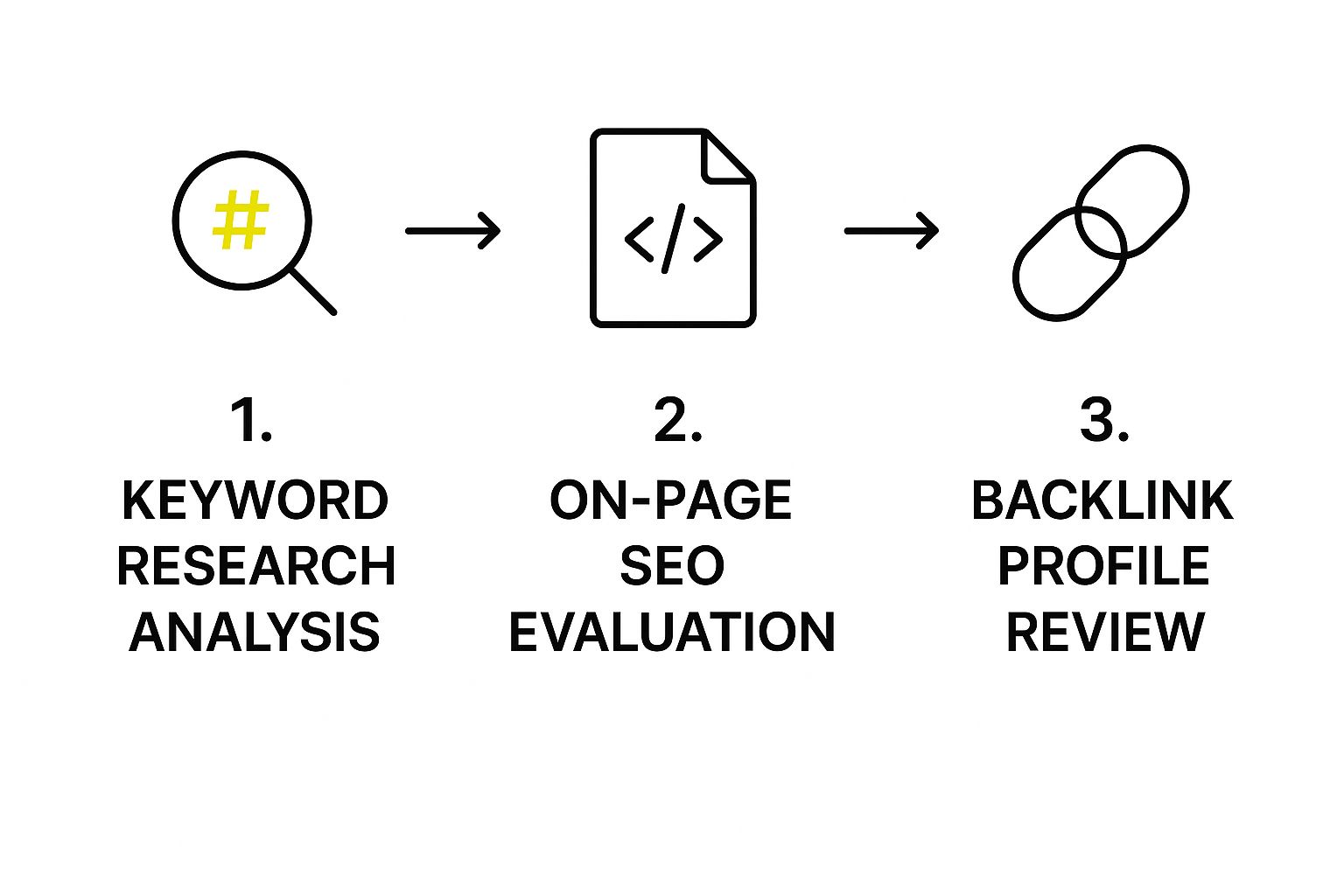
The infographic above shows the SEO component of a comprehensive ecommerce audit. It highlights the process, from Keyword Research Analysis to On-Page SEO Evaluation and finally, Backlink Profile Review. This process helps improve organic search visibility and drive targeted traffic to your online store. Analyzing these three key areas provides a complete understanding of your website's SEO performance and identifies areas for improvement.
Prioritizing Audit Elements
All the components mentioned above are important, but prioritizing them based on your specific needs and business goals is crucial. For instance, if your site has a high bounce rate, focus on user experience and conversion optimization rather than small technical issues. If you're struggling to attract organic traffic, SEO should be your top priority. You might also find value in resources like How to master your Shopify store audits.
To help with prioritization, consider the following table:
Ecommerce Audit Components Priority Matrix
A comprehensive breakdown of audit components ranked by business impact and implementation difficulty
| Audit Component | Business Impact | Implementation Difficulty | Recommended Priority |
|---|---|---|---|
| Technical Performance Evaluation | High | Medium | High |
| User Experience Assessment | High | Medium | High |
| Conversion Optimization Analysis | High | Medium | High |
| Security Protocols Review | High | High | Medium |
| SEO Performance Evaluation | Medium | Medium | Medium |
This table helps visualize the balance between potential impact and the effort required for each audit component. This allows you to allocate resources effectively. For example, technical performance, user experience, and conversion optimization all offer high business impact for a moderate implementation difficulty, making them high priority.
Balancing Depth and Efficiency
A comprehensive ecommerce website audit doesn't have to be overwhelming. Break the process into smaller steps, focusing on areas with the biggest impact. This approach helps achieve significant improvements without stretching your team or resources. This involves a clear audit plan, realistic timelines, and efficient tools. Automated website audit tools can streamline the process and quickly identify technical issues and SEO opportunities. Using analytics data gives insights into user behavior and pinpoints areas for conversion optimization. By balancing comprehensive analysis with efficient execution, your audit efforts will be focused and productive.
Mastering User Experience And Conversion Optimization

In the world of ecommerce, turning website visitors into paying customers is the ultimate goal. This is where a successful ecommerce website audit comes into play. It analyzes every point of the customer journey, from the initial landing page visit to the final purchase confirmation.
Analyzing User Behavior for Insights
Understanding how users interact with your website is crucial. Tools like heat maps and conversion funnels provide valuable data on user behavior, showing where customers are leaving the site. This information helps pinpoint areas for improvement.
For example, if many users abandon their carts during the shipping information step, simplifying this process could significantly boost your conversion rate.
Analyzing user behavior data also helps understand why customers are struggling. Is the form too complex? Are the shipping options confusing? Answering these questions is the key to effective optimization. Regular ecommerce website audits are crucial for spotting improvement opportunities. These audits examine aspects like user experience (UX), technical functionalities, and website security. For instance, 87% of consumers are unlikely to return after a negative experience due to inaccurate product information. Find more detailed statistics here Audits help keep product details accurate and current, essential for customer satisfaction. Additionally, they identify technical problems that might impact user experience, like slow loading times or poor mobile responsiveness. Addressing these issues leads to better conversion rates and happier customers, which, in turn, drives sales and revenue growth.
Optimizing Key Touchpoints for Conversions
Optimizing your product pages is critical for conversions. Here's what to look for during an ecommerce website audit:
-
Product Page Optimization: Use high-quality images, compelling product descriptions, clear pricing, and easy-to-find customer reviews.
-
Streamlined Checkout Process: A long or complex checkout process often leads to cart abandonment. Simplify the steps, provide guest checkout, and offer various payment options.
-
Enhanced Mobile Responsiveness: As mobile shopping grows, your website must provide a seamless mobile experience. This includes fast load times, touch-friendly navigation, and mobile-specific features.
Evaluating Navigation and Checkout Flow
Easy navigation lets users quickly find what they need without frustration. A smooth checkout flow is also vital for maximizing conversions. A comprehensive ecommerce website audit assesses both areas, pinpointing pain points and opportunities for improvement. This involves analyzing user flow, evaluating the website architecture, and creating a clear path from product discovery to purchase. By prioritizing these elements, you create a positive user experience that translates to increased sales and customer satisfaction. Through optimization, your website becomes a conversion and revenue-generating machine. Your ecommerce website audit will give you the information you need to optimize these key areas.
Technical Performance That Actually Drives Sales
This section explores the critical technical aspects of your ecommerce website that often get overlooked, but significantly impact your success. These behind-the-scenes elements can make or break your online store's ability to convert visitors into paying customers. A thorough ecommerce website audit must address these key areas.
Website Speed Optimization: More Than Just a Number
Website speed is crucial. It directly affects user experience, conversion rates, and how well you rank in search engines. But optimizing for speed goes beyond just running a simple speed test.
-
Understanding Key Metrics: Pay close attention to metrics like load time, Time to First Byte (TTFB), and Core Web Vitals. These provide detailed insights into your website's performance. Aim for a load time of under two seconds, a TTFB below 0.8 seconds, and strive to meet Google's Core Web Vitals standards.
-
Performance Testing Strategies: Test your website's performance under different traffic loads. This helps identify potential bottlenecks that could slow things down during busy shopping periods, ensuring your site remains fast and stable even under pressure. This data then provides a clear roadmap for practical improvements. Interested in learning more? Check out this helpful resource: How to master Shopify performance optimization.
Mobile Responsiveness: Catering to the On-the-Go Shopper
With so much online shopping happening on mobile devices, optimizing your website for mobile is absolutely essential. It's a critical component of any comprehensive ecommerce website audit.
- Going Beyond Responsive Design: While having a responsive design is important, consider features like Accelerated Mobile Pages (AMP) to make your site load even faster on mobile. Make sure your site navigation is touch-friendly, designed specifically for mobile users. Technical issues can seriously impact ecommerce success, and page load speed is a major factor. Research shows that a one-second delay in page load time can lead to a 7% reduction in conversions, 11% fewer page views, and a 16% decrease in customer satisfaction. For ecommerce businesses, this translates directly to lost revenue. Furthermore, 53% of mobile users will abandon a site that takes longer than three seconds to load. This makes mobile optimization crucial for success in today's mobile-first shopping world. Explore this topic further
Security and Backend Functionality: The Unsung Heroes
Security isn't just about protecting data; it's about building trust with your customers. A secure website gives shoppers confidence, leading to increased conversions.
-
Essential Security Assessments: Regular security checks, including SSL verification, payment gateway evaluation, and data protection compliance, are essential for maintaining a secure online environment.
-
Backend Optimization: Focus on database optimization and server configuration assessments. These behind-the-scenes improvements ensure your website runs smoothly, handling changes in traffic without impacting performance. Improving conversion rates is a key goal of a comprehensive ecommerce website audit. These conversion rate optimization techniques can help. A technically sound website, optimized for both performance and security, is the foundation of a thriving ecommerce business. It creates a smooth and enjoyable experience for your customers, encourages conversions, and builds long-term loyalty.
SEO And Marketing Performance That Gets Results
A successful ecommerce website audit goes beyond technical fixes and UX improvements. It dives into the core of your online store's visibility and how effectively you're attracting and converting customers through search and marketing. This is where understanding your SEO and marketing performance becomes critical.
Auditing Your Keyword Optimization Strategy
Keywords are the foundation of organic search visibility. A thorough audit examines how well your current keywords align with customer search intent and contribute to your overall business goals. This involves analyzing several key aspects:
-
Keyword Relevance: Are your target keywords truly relevant to your products and your target audience's needs? Irrelevant keywords drive unqualified traffic that rarely converts.
-
Search Volume: Are you targeting keywords with enough search volume to make a real impact on your traffic? While niche keywords can be valuable, they need sufficient search volume to justify your optimization efforts.
-
Keyword Difficulty: How competitive are your target keywords? Understanding keyword difficulty helps you focus on achievable ranking opportunities and avoid wasting resources on highly competitive terms.
Evaluating Content Quality and Backlink Profile
Content is king, especially for ecommerce. Your audit should assess how well your content supports your SEO strategy and engages your target audience. This includes looking at:
-
Product Page Content: Do your product pages have compelling descriptions, high-quality images, and sufficient information to encourage purchases? This is crucial for both user experience and search engine rankings.
-
Blog Content and Articles: Are you creating valuable content that attracts potential customers, educates them about your products, and positions you as an authority? Engaging blog posts can drive significant organic traffic.
-
Backlink Profile: Which websites are linking to your online store? High-quality backlinks from reputable sources are a signal of trust and authority to search engines, boosting your overall rankings. Ensuring top-notch technical performance is also key for driving sales. For expert help, consider technical SEO services.
Analyzing Marketing Funnel Effectiveness
Beyond SEO, your audit should examine your entire marketing funnel, assessing how effectively your marketing drives conversions. This means analyzing:
-
Traffic Sources: Where is your website traffic coming from? Understanding your traffic sources highlights which channels are performing well and which need improvement.
-
Conversion Attribution: How are different marketing channels contributing to conversions? Tracking conversion attribution allows you to allocate resources efficiently and optimize underperforming channels.
-
Customer Journey Analysis: How are customers interacting with your marketing at different stages of the buying process? These insights can help you personalize marketing messages and improve conversion rates. SEO-optimized ecommerce sites see markedly better performance across key metrics. Studies show sites with strong SEO foundations experience 53% more organic traffic and 47% higher conversion rates. Also, 68% of online experiences start with a search engine, making SEO vital for ecommerce visibility. Optimized product pages can increase organic traffic by up to 142%, and proper site structure and internal linking can significantly boost site authority and search rankings. Discover more insights about ecommerce SEO performance
Advanced Techniques for Sustainable Growth
For sustained growth, your ecommerce website audit should explore more advanced techniques:
-
Local SEO Performance: Are you optimizing for local searches? This is especially important for businesses with physical locations or those serving specific geographic areas.
-
Competitive Positioning: How do you compare to your competitors in terms of search visibility and market share? Competitor analysis can reveal opportunities to improve your own performance.
-
Content Strategy Audit: Are you creating the right content to attract and engage your target audience at each stage of their buying journey? A thorough content audit ensures your content aligns with your business goals. Consider exploring Shopify Plus solutions for enhanced ecommerce capabilities.
By optimizing your SEO and marketing through a comprehensive ecommerce website audit, you can attract the right traffic, convert visitors into loyal customers, and maximize your online store’s revenue potential. This data-driven approach provides valuable insights and sets the stage for lasting growth and success.
Analytics That Transform Audit Findings Into Profit

An ecommerce website audit provides a lot of data about your online store. But data alone doesn't tell the whole story. We need to understand what it means. This section explores how to turn those audit insights into actionable strategies that boost profits. Think of your audit data as ingredients, and analytics as the recipe for success.
Leveraging Google Analytics and Ecommerce Tracking
Google Analytics offers powerful tools to analyze website traffic, user behavior, and conversions. Ecommerce tracking adds another layer, providing key details about sales, product performance, and customer lifetime value.
Let's explore some ways to use these tools effectively.
-
Setting Up Comprehensive Tracking: Make sure you're tracking important metrics. These include transactions, revenue, average order value, and individual product performance. This foundational setup in Google Analytics is essential for making data-driven decisions.
-
Creating Meaningful Performance Dashboards: Design dashboards to visualize the key performance indicators (KPIs) that relate to your audit findings. This allows you to monitor the impact of changes and track progress. A good dashboard offers a clear view of your website's health.
-
Establishing Benchmarks for Ongoing Audits: Use your historical data to create performance benchmarks. This gives you a starting point for measuring how effective your future optimizations are. For example, if your average conversion rate is currently 2%, aim to increase it to 2.5% after implementing the audit recommendations.
Utilizing Custom Metrics for Deeper Insights
Standard metrics offer a good overview, but custom metrics in Google Analytics allow you to track data specific to your business. This is where you can really fine-tune your analysis. You can connect audit findings to particular areas for improvement.
Here's how to use custom metrics effectively:
-
Tracking Unique User Behavior: Set up custom metrics to track specific actions users take on your website. Examples include video views, file downloads, or interactions with certain page elements. This data shows how users engage with your content and identify areas to improve.
-
Measuring the Impact of Design Changes: Track the effects of website design changes using custom metrics. Monitor click-through rates on a redesigned call-to-action button to assess its effectiveness. This applies to changes in button placements, color schemes, and navigation.
-
Correlating Audit Findings with Revenue Impact: Link your custom metrics directly to revenue. This shows which audit recommendations have the most significant financial impact. For instance, if optimizing product images increases conversions by 10%, you can calculate the revenue generated from that single improvement.
Building Data-Driven Audit Processes
Data-driven audit processes help justify the return on investment (ROI) to stakeholders. Showing the value of data-informed decisions helps secure support for future optimization efforts.
To illustrate the essential metrics to track, consider the following table:
Key Ecommerce Audit Metrics Dashboard
Essential KPIs and metrics to track during and after your ecommerce audit process
| Metric Category | Key Indicators | Target Benchmarks | Audit Frequency |
|---|---|---|---|
| Website Traffic | Sessions, Users, Bounce Rate, Traffic Sources | Industry averages, past performance | Monthly |
| Conversions | Conversion Rate, Average Order Value, Revenue per Session | Improve by X% over previous period | Weekly |
| User Experience | Page Load Time, Mobile Responsiveness, Time on Site | Industry best practices, user testing data | Quarterly |
| SEO Performance | Organic Traffic, Keyword Rankings, Backlink Profile | Increase organic traffic by Y%, improve ranking positions | Monthly |
This table summarizes key metrics and connects them to different audit frequencies. Monitoring these indicators provides a clear picture of website performance. Setting target benchmarks and regular audit frequencies creates a sustainable audit process.
Strategies for Continuous Improvement
Successful ecommerce businesses use audit data not just for one-time fixes, but for ongoing improvements.
Here are a few ways to do that:
-
Regularly Review and Analyze Data: Create a consistent schedule for reviewing your analytics. Regular analysis helps you identify trends, catch problems early, and be proactive with adjustments.
-
Integrate Data Into Decision-Making: Base your decisions on the data you collect. Use data to validate audit findings, measure the impact of changes, and prioritize future optimizations.
-
Build a Culture of Data-Driven Optimization: Encourage everyone on your team to use data analysis in their daily work. This empowers everyone to contribute to continuous improvement.
By incorporating these analytics strategies into your ecommerce website audit, you'll transform raw data into actionable insights. These insights drive profits and turn your website into a revenue-generating machine.
Key Takeaways
Your ecommerce website audit has uncovered a lot of information. Now, it's time to put those insights into action. This section offers a practical guide for implementing changes based on potential ROI, resources, and timelines.
Prioritizing Improvements Based on Potential ROI
Not all audit findings are created equal. Prioritize improvements based on their potential impact on your profits. For example, fixing a broken checkout process has a more immediate impact on revenue than tweaking a blog post. Addressing a slow mobile site, which can be identified using tools like Google PageSpeed Insights, should come before minor content adjustments.
Use a priority matrix to organize findings and tackle the most impactful changes first. This focused approach maximizes your resources and delivers the best returns. Also, consider the complexity of implementation. Some fixes are quick, while others require significant developer time. Balancing potential impact with feasibility is essential.
Strategies for Approaching Audit Implementation
A structured approach is key for successful implementation. Start by creating a detailed plan, broken down into smaller, manageable tasks. Each task should have a designated owner and measurable success metrics.
For example, if your goal is to improve mobile page speed, your success metric could be a specific percentage decrease in load time. Set realistic deadlines for each task to keep progress on track. Regularly review and adjust the plan as needed to stay agile and responsive to changing circumstances.
Coordinating Team Efforts and Tracking Progress Effectively
Ecommerce website audits often involve multiple teams, from marketing and development to customer service. Effective communication and collaboration are essential for success. Use project management tools to track progress, share updates, and keep everyone informed.
Regularly communicate progress and any roadblocks to stakeholders. This transparency maintains support for optimization efforts and keeps everyone aligned.
Quick Wins and Long-Term Optimization Projects
Find a balance between quick wins and long-term projects. Quick wins, such as optimizing product images or streamlining the checkout, provide immediate value and demonstrate progress. Long-term projects, like a website redesign or platform migration, require more time and resources but build a foundation for sustainable growth. This balanced approach maintains momentum while setting the stage for future success.
Measuring Success and Celebrating Wins
Track key metrics after implementing changes. This quantifies the impact of your optimization efforts and justifies future investment in audits. Celebrate successes to keep the team motivated and recognize their contributions. This positive feedback reinforces the value of data-driven optimization.
By following these key takeaways, you can transform your ecommerce website audit from a data dump into a powerful growth engine. Remember, continuous improvement is an ongoing process. Regular audits, data analysis, and proactive optimization are crucial for maximizing your online store's potential.
Are you ready to take your Shopify store to the next level? E-commerce Dev Group offers comprehensive Shopify design, development, and support services. From store design and app integration to performance optimization and ongoing support, we help you build a high-performing online store. Visit us at E-commerce Dev Group to learn more and schedule a consultation.
