

Understanding the Power of Customer Journey Templates
Want to boost customer satisfaction and drive sales? This listicle reveals six powerful customer journey templates to help you visualize and optimize your customers' experiences. Learn how these templates—from Customer Journey Map Canvases to Digital Customer Journey Analytics Dashboards—can pinpoint pain points and unlock opportunities to enhance every interaction. A well-chosen customer journey template is essential for any successful business, enabling you to improve customer engagement and ultimately, your bottom line. Let's dive in.
1. Customer Journey Map Canvas
A Customer Journey Map Canvas is a powerful customer journey template that provides a comprehensive visual overview of your customer's entire experience with your brand. It plots the journey on a single canvas, using lanes or "swimlanes" to represent different stages of interaction, from initial awareness to post-purchase engagement. This format allows you to visualize the customer's actions, emotions, touchpoints, and pain points at each phase, giving you a holistic understanding of their relationship with your product or service. This makes it an invaluable tool for anyone working on customer experience optimization, especially for Shopify merchants looking to enhance their online store's performance and boost customer satisfaction.
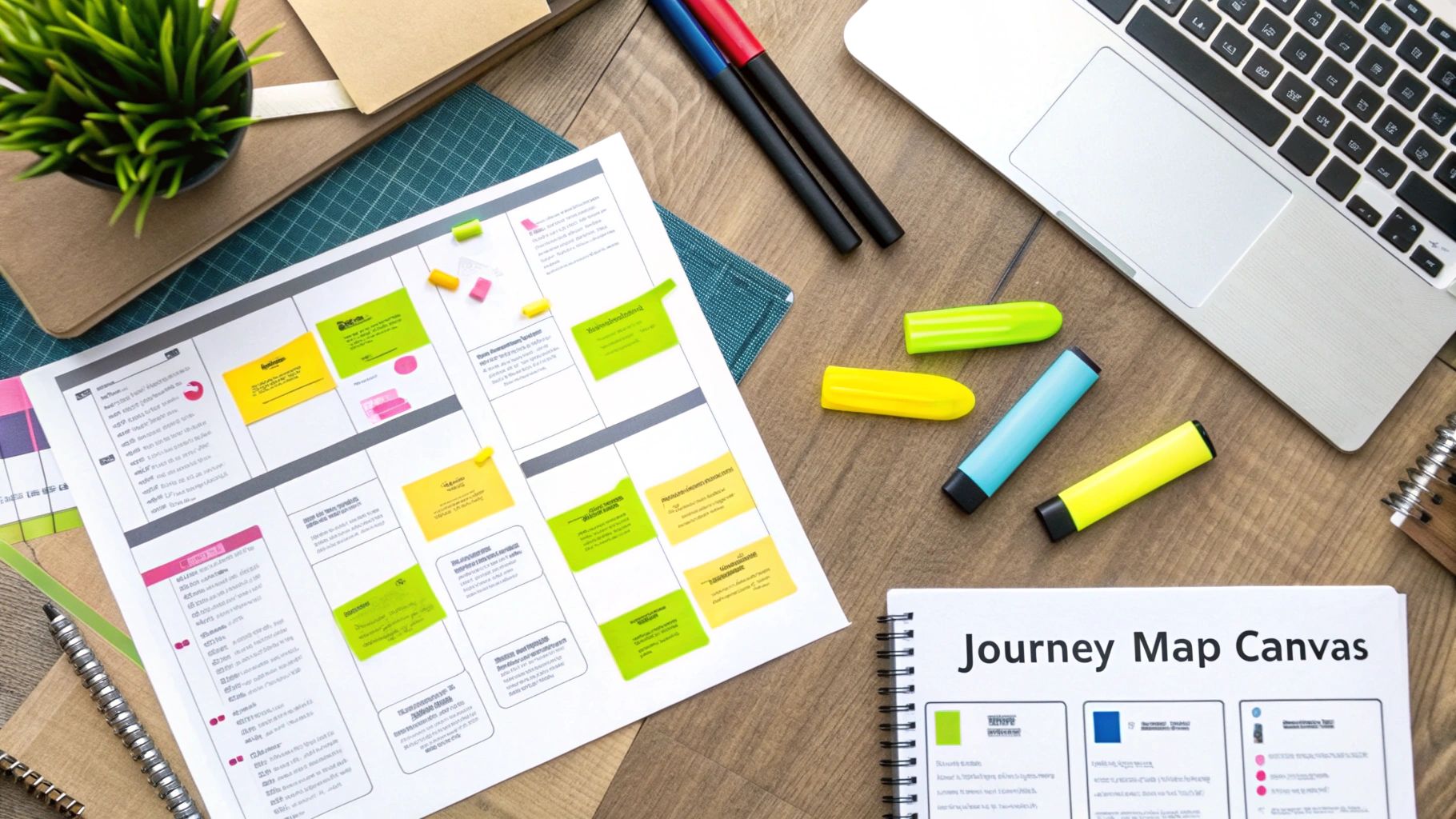
The Customer Journey Map Canvas earns its top spot on this list due to its comprehensive nature and ease of use. Its visual format facilitates collaboration and quick identification of critical areas for improvement within the customer journey. Specific features include multi-lane visualization with clear sections for different journey phases, dedicated areas for customer actions, emotions, touchpoints, and pain points, a timeline-based approach to visualize the full experience, the integration of customer personas with journey stages, and opportunity identification sections. This customer journey template helps bridge the gap between different departments, ensuring everyone understands the customer’s perspective. For Shopify Plus users managing complex sales funnels and multiple customer segments, a Customer Journey Map Canvas is particularly beneficial in identifying areas for improvement and optimizing conversion rates.
Examples of Successful Implementation:
- IDEO's customer journey mapping for healthcare patient experiences: IDEO, a prominent design consultancy, has used this method to map complex patient experiences, helping healthcare providers streamline processes and enhance patient care.
- Amazon's shopping experience journey mapping: Amazon meticulously maps its customer shopping journey to optimize every touchpoint, from product discovery to delivery and post-purchase support, leading to a seamless and personalized customer experience.
- Starbucks' in-store and digital experience integration journey: Starbucks utilizes journey mapping to ensure a consistent brand experience across both physical stores and digital platforms, creating a cohesive and satisfying customer interaction regardless of the channel.
Actionable Tips for Shopify Merchants:
- Start with clear customer personas: Before mapping, define your target customer segments and their specific needs and motivations. This allows for a more targeted and effective journey map.
- Include both emotional and functional aspects at each stage: Understand not only what your customers are doing but also how they are feeling. This provides valuable insights into customer satisfaction and potential pain points.
- Use color-coding to highlight emotions or satisfaction levels: Visual cues make it easier to identify areas where the customer experience is excelling or falling short.
- Keep the canvas visible to teams working on customer experience: Promote transparency and collaboration by making the customer journey map accessible to all relevant stakeholders.
- Update regularly as new customer insights emerge: Customer behavior and preferences change over time. Regularly review and update your map to ensure it remains relevant and accurate.
When and Why to Use This Approach:
Use a Customer Journey Map Canvas when you want to gain a comprehensive understanding of your customer's experience and identify opportunities to improve it. This is particularly valuable for:
- Onboarding new customers: Optimize your onboarding process to reduce friction and increase customer retention.
- Improving conversion rates: Identify bottlenecks in the sales funnel and optimize key touchpoints to drive conversions.
- Enhancing customer loyalty: Understand the factors that contribute to customer loyalty and identify opportunities to strengthen customer relationships.
- Launching new products or services: Map the anticipated customer journey for new offerings and proactively address potential pain points.
Pros:
- Provides a comprehensive single-view format
- Helps identify disconnects across customer touchpoints
- Makes it easy to spot pain points and opportunities
- Excellent for cross-functional team alignment
- Highly visual and easy to present to stakeholders
Cons:
- Can become overwhelming with too much detail
- Sometimes oversimplifies complex customer journeys
- Requires significant research to complete accurately
- Static representation that needs regular updating
- May not capture all customer segments in one map
By using this powerful customer journey template, Shopify merchants can gain a deeper understanding of their customers’ needs and preferences, optimize their online store for a better user experience, and ultimately drive sales and build stronger customer relationships.
2. Empathy Map Template
The Empathy Map Template is a valuable customer journey template that goes beyond simply tracking customer actions. It delves into the emotional and psychological aspects of the customer experience, offering a powerful way to understand what truly drives your customers. Instead of focusing on business processes, this customer-centric approach prioritizes understanding your customers' thoughts, feelings, what they see and hear, what they say and do, allowing your team to build deeper emotional intelligence. This makes it a crucial tool for anyone working on a customer journey template.
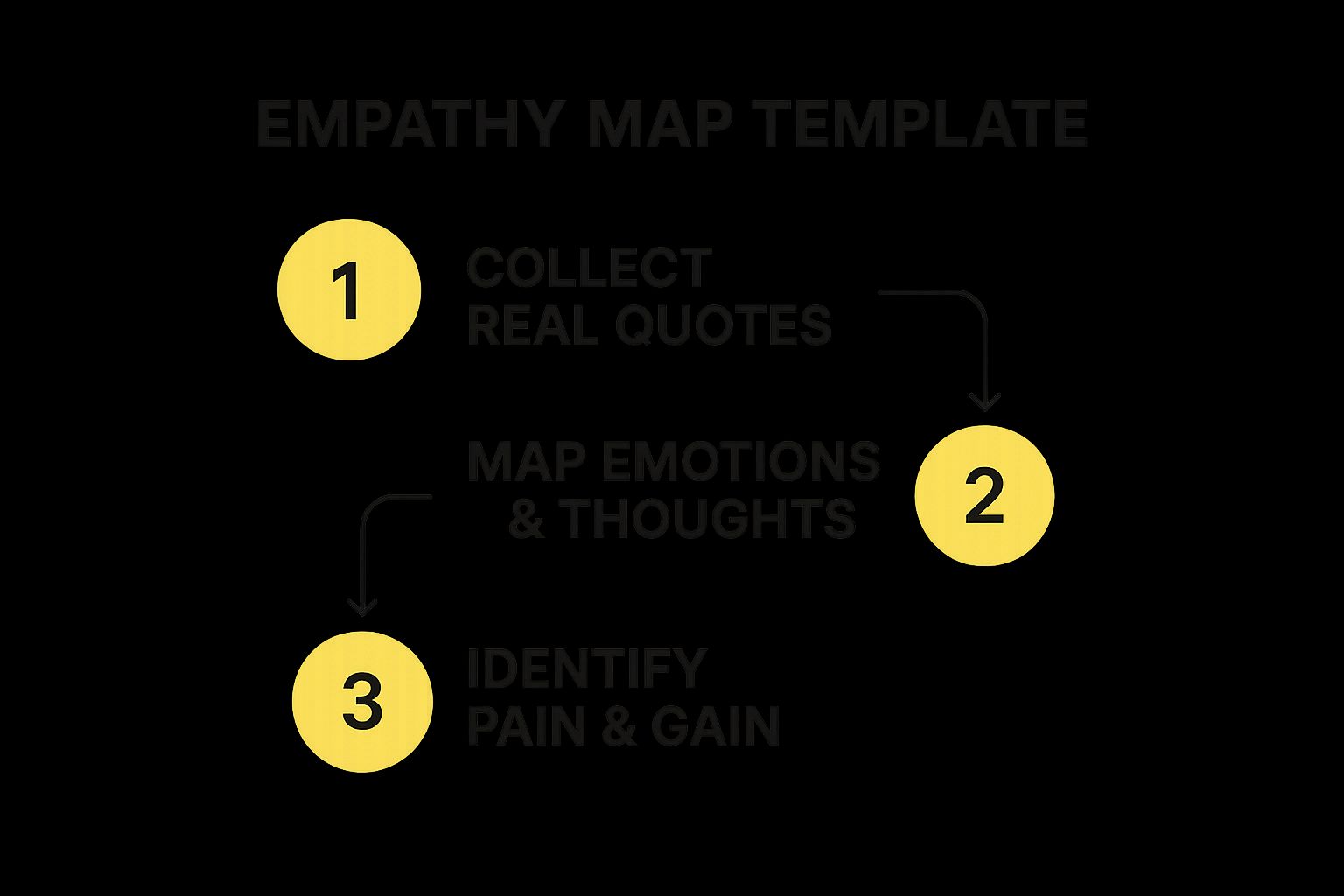
The infographic above visualizes the process of creating an Empathy Map, outlining its four key quadrants: Think and Feel (internal states), Hear and See (external influences), and Say and Do (resulting actions). The flow emphasizes starting with understanding the customer's environment (See & Hear) which influences their internal state (Think & Feel), culminating in their actions and words (Say & Do). This sequence is crucial for gaining genuine empathy and understanding the why behind customer behavior. The infographic also highlights the importance of centering the map around a specific persona or customer segment.
This powerful tool uses a quadrant-based layout, typically divided into Think, Feel, Say/Do, and Hear/See. It emphasizes verbatim customer quotes and observed behaviors, further enriching its insights with specific pain and gain sections to pinpoint customer frustrations and positive experiences. Learn more about Empathy Map Template
This method deserves its place in this list because it provides a crucial layer of understanding that other customer journey templates often miss. Its focus on empathy helps businesses develop products, services, and marketing strategies that truly resonate with their target audience.
Features and Benefits:
- Quadrant-based layout: Provides a clear framework for organizing customer insights.
- Customer-centric focus: Prioritizes customer emotions and needs above all else.
- Integration with personas: Allows for tailoring the map to specific customer segments.
- Emphasis on verbatim quotes: Adds authenticity and depth to the insights gathered.
- Pain and gain identification: Highlights areas for improvement and opportunities for enhancement.
Pros:
- Builds genuine customer empathy across teams.
- Humanizes data and research findings.
- Easily understood by teams with various backgrounds.
- Effective for identifying emotional pain points that quantitative data misses.
- Relatively quick to create compared to comprehensive journey maps.
Cons:
- Less structured approach to mapping the full customer journey.
- May lack detailed touchpoint analysis.
- Requires significant qualitative research to be effective.
- Can become subjective without proper customer data.
- Not as focused on system interactions or technical processes.
Examples of Successful Implementation:
- IDEO's empathy mapping for healthcare patient experiences
- Airbnb's host and guest empathy mapping
- Microsoft's empathy mapping for accessibility experiences
Actionable Tips for Using Empathy Maps:
- Conduct thorough research: Before creating your map, conduct interviews, surveys, and direct observations to gather rich qualitative data.
- Use real customer quotes: Incorporate direct quotes from customers to add context and authenticity.
- Segment your audience: Create separate empathy maps for different customer segments to account for varying needs and perspectives.
- Regularly update your maps: As your customer base evolves, ensure your empathy maps reflect the latest insights.
- Integrate with other tools: Use empathy maps in conjunction with other customer journey mapping tools for a comprehensive understanding.
When and Why to Use an Empathy Map:
Empathy maps are particularly useful when:
- Developing new products or services: Understand customer needs and pain points to create solutions that resonate.
- Improving existing offerings: Identify areas for improvement and enhance the customer experience.
- Crafting targeted marketing campaigns: Develop messaging and content that speaks directly to customer emotions and motivations.
- Building stronger customer relationships: Foster empathy and understanding within your team to better serve your customers.
For established Shopify merchants, business owners, and e-commerce managers, understanding the emotional drivers behind customer behavior is paramount. The Empathy Map Template provides a valuable tool for gaining this crucial insight, allowing you to optimize every aspect of your business for a truly customer-centric approach. This method allows you to move beyond surface-level data and connect with your customers on a deeper emotional level, ultimately leading to increased customer satisfaction, loyalty, and business growth.
3. Service Blueprint Template
The Service Blueprint template is a powerful customer journey template that goes beyond the customer-facing experience. It dives deep into the internal workings of your business, mapping out the processes, systems, and people involved in delivering each customer interaction. This comprehensive view makes it an invaluable tool for optimizing operations and enhancing the customer experience, ultimately driving growth for your Shopify business. This layered approach helps organizations understand the full operational infrastructure needed to deliver the customer experience, making it particularly valuable for service design and operational improvements. It deserves a place on this list because it provides a detailed, holistic view of the customer journey, facilitating targeted improvements that directly impact business outcomes.

Think of a service blueprint as a multi-layered diagram. It visually represents the customer journey from start to finish, highlighting all touchpoints across different channels (e.g., your Shopify store, social media, email). Crucially, it then reveals the "backstage" – the internal processes, systems, and teams that support each customer interaction. A "line of visibility" separates the customer-facing aspects from these internal workings. This clear distinction helps pinpoint areas for improvement, showing how internal changes can directly affect the customer experience. For example, streamlining your fulfillment process (backstage) can lead to faster shipping times (customer-facing), boosting customer satisfaction.
Features of a service blueprint include a multi-layered structure, a clear line of visibility separating frontstage and backstage actions, detailed touchpoint mapping, integration of time metrics and service standards, and the identification of critical moments and failure points. These features enable businesses to understand the intricacies of their operations and identify areas for optimization.
Why use a Service Blueprint?
For Shopify merchants, a Service Blueprint is particularly beneficial for understanding and improving complex customer journeys, especially in omnichannel environments. It helps you identify bottlenecks, streamline operations, and ensure consistent brand experiences across all touchpoints. This is crucial for established Shopify merchants, enterprise clients, and Shopify Plus users handling high volumes of orders and customer interactions.
Examples of Successful Implementation:
- Mayo Clinic: Used service blueprints to map and improve patient experiences, resulting in increased patient satisfaction and operational efficiency.
- Virgin Atlantic: Developed a service blueprint for their end-to-end travel experience, enabling them to identify and address pain points in the customer journey.
- Nordstrom: Leveraged service blueprints to optimize their omnichannel shopping experience, ensuring seamless transitions between online and offline touchpoints.
Actionable Tips for Creating a Service Blueprint:
- Start with the customer: Map the customer journey before delving into internal processes.
- Collaborate: Involve employees from various departments (e.g., marketing, fulfillment, customer service) to gain a comprehensive perspective.
- Define ownership: Assign responsibility for each backstage process to ensure accountability.
- Track time: Use time metrics to identify bottlenecks and areas for improvement.
- Go digital: Create a digital version of your service blueprint for easy updating and sharing.
Pros and Cons:
Pros: Connects customer experience directly to operational capabilities; identifies internal process improvements that impact customer experience; excellent for cross-functional collaboration; helps eliminate redundancies and inefficiencies; valuable for training staff on their role in the customer journey.
Cons: Complex and time-consuming to create; requires input from multiple departments; can become overwhelming with too much detail; needs regular updating as processes change; more difficult to explain to non-technical stakeholders.
By visualizing the entire customer journey, from the initial website visit to post-purchase support, and connecting it to your internal operations, a Service Blueprint allows you to identify pain points and optimize the customer experience. This leads to improved customer satisfaction, increased loyalty, and ultimately, greater profitability for your Shopify business. Popularized by banking services innovator G. Lynn Shostack in 1984, the Service Blueprint has become a cornerstone of service design practices championed by organizations like the Service Design Network, Forrester Research, and McKinsey & Company.
4. Experience Mapping Canvas
The Experience Mapping Canvas is a powerful customer journey template that goes beyond simply charting the steps a customer takes. It dives deeper into the emotional landscape of their experience, revealing how they feel at each touchpoint and highlighting the "moments of truth" that significantly shape their overall perception of your brand. This focus on the feeling aspect makes it a valuable tool for Shopify merchants looking to build stronger customer relationships and boost loyalty.
Instead of solely focusing on process flows, this customer journey template emphasizes the customer's emotional journey and mindset throughout their interaction with your brand. Imagine it as a visual story of their experience, from initial awareness to post-purchase engagement. It uses a timeline-based visualization, divided into clear experience phases, to track how emotions shift and where the key moments of truth lie. These moments might be encountering a helpful customer service rep, receiving a personalized email, or experiencing a seamless checkout process. By pinpointing these impactful moments, you can understand what truly resonates with your customers and where you have opportunities to enhance their experience.
For instance, Disney meticulously maps its theme park experience to ensure every interaction, from booking tickets to meeting characters, contributes to the overall magical feeling. Spotify uses experience maps to understand how users listen to music and discover new artists, allowing them to tailor recommendations and improve the user interface. Marriott Hotels maps the guest experience to ensure a comfortable and enjoyable stay, anticipating needs and exceeding expectations. Learn more about Experience Mapping Canvas
Features of an Experience Mapping Canvas:
- Timeline-based visualization: Clearly defines the stages of the customer journey.
- Emotional states and customer mindsets: Dedicated sections to track how customers feel at each stage.
- Moments of truth identification: Highlights the critical interactions that significantly impact the customer's perception.
- Channel integration: Maps the customer journey across multiple touchpoints, including online and offline channels.
- Opportunity spaces: Identifies areas where the experience can be improved.
- Quantitative metrics: Integrates customer satisfaction data at key stages.
Pros:
- Focus on experiences: Provides a richer understanding of the customer journey than process-focused templates.
- Highlights critical moments: Identifies key touchpoints that disproportionately impact customer perception.
- Emotional connection focus: Facilitates opportunities for building deeper emotional connections with customers.
- Flexibility: Adaptable to different business models and industries.
- Qualitative and quantitative: Incorporates both types of data for a comprehensive view.
Cons:
- Less operational detail: Doesn't delve into operational specifics as deeply as service blueprints.
- Balancing emotional and functional aspects: Requires careful consideration to balance both aspects of the experience.
- Research-dependent: Requires a solid foundation of customer research data.
- Complexity: May necessitate multiple canvases for complex products or services.
- Less standardized: Lacks the standardized format of some other customer journey templates.
Actionable Tips for Using an Experience Mapping Canvas:
- Identify true moments of truth: Focus on the interactions that genuinely shape customer opinions.
- Use emotional intensity scales: Visualize the strength of emotions at each stage.
- Connect experience to business outcomes: Demonstrate how experience improvements impact key metrics.
- Use customer verbatims: Include direct customer feedback to illustrate key points.
- Segment your maps: Create separate maps for different customer segments if their experiences differ significantly.
This customer journey template deserves its place in this list because, for Shopify merchants especially, understanding the emotional journey is critical. By using an Experience Mapping Canvas, you can gain valuable insights into what truly drives customer satisfaction and loyalty, allowing you to optimize touchpoints and create more meaningful and memorable experiences that ultimately boost your bottom line. This is particularly important for the target audience of established Shopify merchants, business owners, e-commerce managers, marketing managers, and enterprise clients using Shopify Plus, who are looking to create more personalized and engaging customer journeys. By understanding the emotional highs and lows of the customer experience, these businesses can identify opportunities to improve customer satisfaction, increase conversions, and build stronger brand loyalty.
5. Jobs-to-be-Done Customer Journey Template
The Jobs-to-be-Done (JTBD) Customer Journey Template offers a unique approach to understanding your customers. Instead of simply mapping what customers do, it focuses on why they do it – the "job" they are "hiring" your product or service to accomplish. This framework helps you analyze the functional, emotional, and social dimensions driving customer behavior, revealing valuable insights into their underlying needs and motivations. This template maps how well these "jobs" are fulfilled throughout the customer journey, offering a powerful lens for improving customer experience and driving business growth. For established Shopify merchants, this is invaluable for optimizing the customer journey and increasing conversions.

The JTBD framework helps you move beyond superficial observations of customer behavior and delve into the root causes driving their actions. For example, a customer might be "visiting your website" (the action), but their underlying "job" could be "finding a unique gift for their spouse's birthday" (the motivation). Understanding this "job" allows you to tailor your website experience, product offerings, and marketing messages to better meet that specific need. This customer journey template excels at identifying the "push" and "pull" factors influencing a customer's decision-making process, allowing you to anticipate and address potential pain points or capitalize on opportunities.
Examples of Successful Implementation:
- Intercom: Used JTBD to develop its customer messaging platform, focusing on the "job" of businesses needing to communicate effectively with their customers.
- Procter & Gamble: Employs JTBD in its product innovation process, identifying unmet customer "jobs" to guide the development of new products and services.
- McDonald's: Leveraged JTBD research to expand its breakfast menu, catering to the "jobs" customers needed fulfilled at different times of the morning.
Actionable Tips for Shopify Merchants:
- Start with in-depth customer interviews: Don't just ask what they do on your site, ask why. Focus on understanding their motivations and desired outcomes.
- Use the JTBD format: Frame customer needs as "When I [situation], I want to [motivation], so I can [expected outcome]." For example, "When I am browsing for shoes online, I want to easily compare different styles, so I can quickly find the perfect pair for my outfit."
- Prioritize jobs: Focus on the most important and least satisfied "jobs" to identify areas for immediate improvement on your Shopify store.
- Connect jobs to specific features and experiences: Map how different aspects of your Shopify store address specific customer "jobs." This can inform decisions around site design, product development, and marketing campaigns.
- Test and validate: Continuously test your assumptions about customer "jobs" with real customers to ensure accuracy and relevance.
Pros and Cons:
- Pros: Focuses on the "why," reduces bias towards existing solutions, excellent for innovation, reveals unmet needs effectively, provides clear prioritization.
- Cons: Requires deep customer understanding, more conceptual, less visual, may miss operational details, challenging to validate "job" statements.
When to Use This Approach:
This customer journey template is particularly valuable for:
- Developing new products or services: Identify unmet "jobs" to guide innovation.
- Improving existing customer experiences: Understand the "jobs" your customers are trying to accomplish on your Shopify store and optimize accordingly.
- Developing targeted marketing campaigns: Craft messaging that resonates with the specific "jobs" your target audience is looking to fulfill.
The JTBD Customer Journey Template deserves its place on this list because it provides a powerful framework for understanding the deeper motivations behind customer behavior. By focusing on the “jobs” customers are trying to accomplish, Shopify merchants can gain a competitive advantage, optimize their offerings, and ultimately, drive business growth.
6. Digital Customer Journey Analytics Dashboard
A Digital Customer Journey Analytics Dashboard is a dynamic, data-driven customer journey template that provides a real-time view of how customers interact with your digital touchpoints. Unlike static customer journey templates that rely on assumptions, this approach uses actual customer behavior data to create a "living" visualization of their journey. This makes it an invaluable tool for established Shopify merchants, business owners, e-commerce and IT managers, marketing and brand managers, and enterprise clients seeking Shopify Plus solutions, aiming to optimize their online customer experience. This approach deserves its place on this list because it transforms how you understand and improve your customer journey, shifting from guesswork to data-driven insights.
Instead of theorizing about the customer journey, a Digital Customer Journey Analytics Dashboard reveals exactly how customers navigate your website, app, or other digital platforms. It highlights the paths they take, where they convert, and—crucially—where they drop off. This allows you to pinpoint friction points and optimize the experience for better conversions and customer satisfaction.
How it Works:
The dashboard integrates data from various digital touchpoints, such as your website, mobile app, and email marketing platform. It tracks customer interactions in real-time, visualizing their movement through funnels, highlighting key behavioral segments, and even detecting anomalies that disrupt the journey. For instance, you can see how many users abandon their cart after adding a product, identify the specific step causing the issue, and then test solutions to improve cart completion rates.
Features and Benefits:
- Real-time data visualization of customer journey flows: See how customers move through your digital properties in real-time.
- Funnel analytics for key conversion paths: Analyze conversion rates at each stage of your funnels.
- Behavioral segmentation based on actual customer data: Group customers based on their behavior for targeted marketing and personalization.
- Anomaly detection for journey disruptions: Quickly identify unexpected changes in customer behavior that may signal problems.
- A/B test integration: Measure the impact of changes on the customer journey.
- Cross-device journey tracking: Understand how customers interact with your brand across different devices.
- Session replay integration: Dive deeper into individual customer sessions for qualitative insights. These replays offer a valuable perspective, allowing you to see the customer journey unfold through their eyes.
Pros:
- Based on actual behavior: Provides accurate insights into customer actions.
- Continuously updated: Always reflects the latest customer interactions.
- Quantitative metrics: Offers measurable data for each journey stage.
- Immediate problem detection: Quickly identifies and addresses customer experience issues.
- Data-driven decision making: Supports informed decisions about experience improvements.
Cons:
- Digital focus: Primarily focused on digital interactions, potentially missing offline touchpoints.
- Technical implementation: Requires significant technical setup and integration.
- Privacy concerns: Requires careful handling of customer data to ensure privacy compliance.
- Emotional and contextual gaps: May not capture the full emotional context of the customer journey.
- Cost: Can be expensive to implement and maintain, particularly for smaller businesses.
Examples:
- Google Analytics 4 customer journey analysis
- Adobe Experience Platform's real-time customer journey analytics
- Mixpanel's advanced user flow analytics
- Heap's retroactive user journey analytics
Tips for Implementation:
- Define clear business questions: Focus your analysis on specific goals and KPIs.
- Combine quantitative and qualitative data: Supplement dashboard data with user research and feedback for a holistic view.
- Ensure data privacy: Adhere to data governance and privacy regulations.
- Start small: Begin with key conversion journeys before expanding to other areas.
- Set up alerts: Monitor significant changes in journey patterns to proactively address issues.
When to Use This Approach:
A Digital Customer Journey Analytics Dashboard is ideal when you need to understand the actual behavior of your customers on your digital platforms. This is particularly valuable for Shopify Plus users and enterprise clients seeking to optimize complex e-commerce journeys. If you’re relying on assumptions or outdated data, this approach can provide the clarity you need to drive data-backed improvements. Learn more about Digital Customer Journey Analytics Dashboard
6 Customer Journey Template Comparison
| Template | Core Features / Focus | User Experience & Quality ★ | Value Proposition 💰 | Target Audience 👥 | Unique Selling Points ✨ |
|---|---|---|---|---|---|
| Customer Journey Map Canvas | Multi-lane visual, emotions, touchpoints, pain points | ★★★★☆ Comprehensive & visual | 💰 Flexible pricing, solid coding | 👥 Cross-functional teams | 🏆 Single-view, easy stakeholder presentation |
| Empathy Map Template | Emotions, thoughts, sensory focus | ★★★★☆ Builds deep empathy | 💰 Quick to create, humanizes data | 👥 Teams building emotional connections | ✨ Prioritizes customer emotions and quotes |
| Service Blueprint Template | Multi-layered, frontstage/backstage, process details | ★★★★☆ Operational & detailed | 💰 Investment in operational insight | 👥 Ops-focused orgs, service designers | 🏆 Links experience to internal operations |
| Experience Mapping Canvas | Emotional journey, moments of truth, cross-channel | ★★★★☆ Emotional & flexible | 💰 Adaptable to various business models | 👥 Brands focusing on memorable experiences | ✨ Emphasizes emotional intensity & quant. |
| Jobs-to-be-Done Journey Template | Customer outcomes, job statements, success metrics | ★★★★☆ Innovation & unmet needs | 💰 Supports product innovation efforts | 👥 Product teams, innovation-focused orgs | 🏆 Focus on customer "why" and prioritization |
| Digital Customer Journey Analytics | Real-time data, funnel analysis, segmentation | ★★★★☆ Data-driven, continuous | 💰 May require tech investment | 👥 Digital-first, data-savvy companies | ✨ Dynamic, real-time journey visualization |
Choosing the Right Customer Journey Template
Selecting the right customer journey template is crucial for understanding your customers and optimizing their experience. We've explored several powerful options, from the Customer Journey Map Canvas for a broad overview to the highly specific Digital Customer Journey Analytics Dashboard. Key takeaways include understanding the core stages of your customer's journey, identifying pain points, and uncovering opportunities to enhance their interactions with your brand. Remember, whether you're using an Empathy Map to connect with customer emotions or a Service Blueprint to refine your operational processes, each template offers a unique perspective on the customer experience.
When choosing a customer journey template, it's essential to select one that aligns with your specific business needs and goals. For a comprehensive resource and a ready-to-use template, check out this helpful guide: Customer Journey Mapping Template from ECORN to boost your results. By mastering these concepts and applying the right customer journey template, you can gain invaluable insights that translate into increased customer satisfaction, loyalty, and ultimately, business growth.
Mastering the customer journey is no longer a luxury—it's a necessity for thriving in today's competitive landscape. Take the next step and transform your customer experience. E-commerce Dev Group specializes in crafting seamless and engaging Shopify experiences, leveraging customer journey insights to drive conversions and build lasting relationships. Connect with E-commerce Dev Group today to learn how we can help you optimize your customer journey and elevate your brand.
