


Ready to Rank Higher? Dive into Shopify SEO!
Want more organic traffic to your Shopify store? This Shopify SEO checklist provides 7 actionable steps to improve your search engine rankings. From keyword research to link building, this list covers essential on-page and off-page SEO tactics. Mastering these core concepts is crucial for attracting customers and growing your business. Implement this Shopify SEO checklist and watch your online store climb the search results.
1. Keyword Research and Implementation
Thorough keyword research is the bedrock of any successful Shopify SEO strategy. It involves identifying the specific search terms potential customers use when looking for products like yours online and then strategically integrating those keywords throughout your online store. This includes incorporating them into product titles, descriptions, meta descriptions, image alt text, and other relevant content areas. This process helps search engines understand what your products are about and match them with relevant user searches, ultimately driving more targeted traffic to your store.
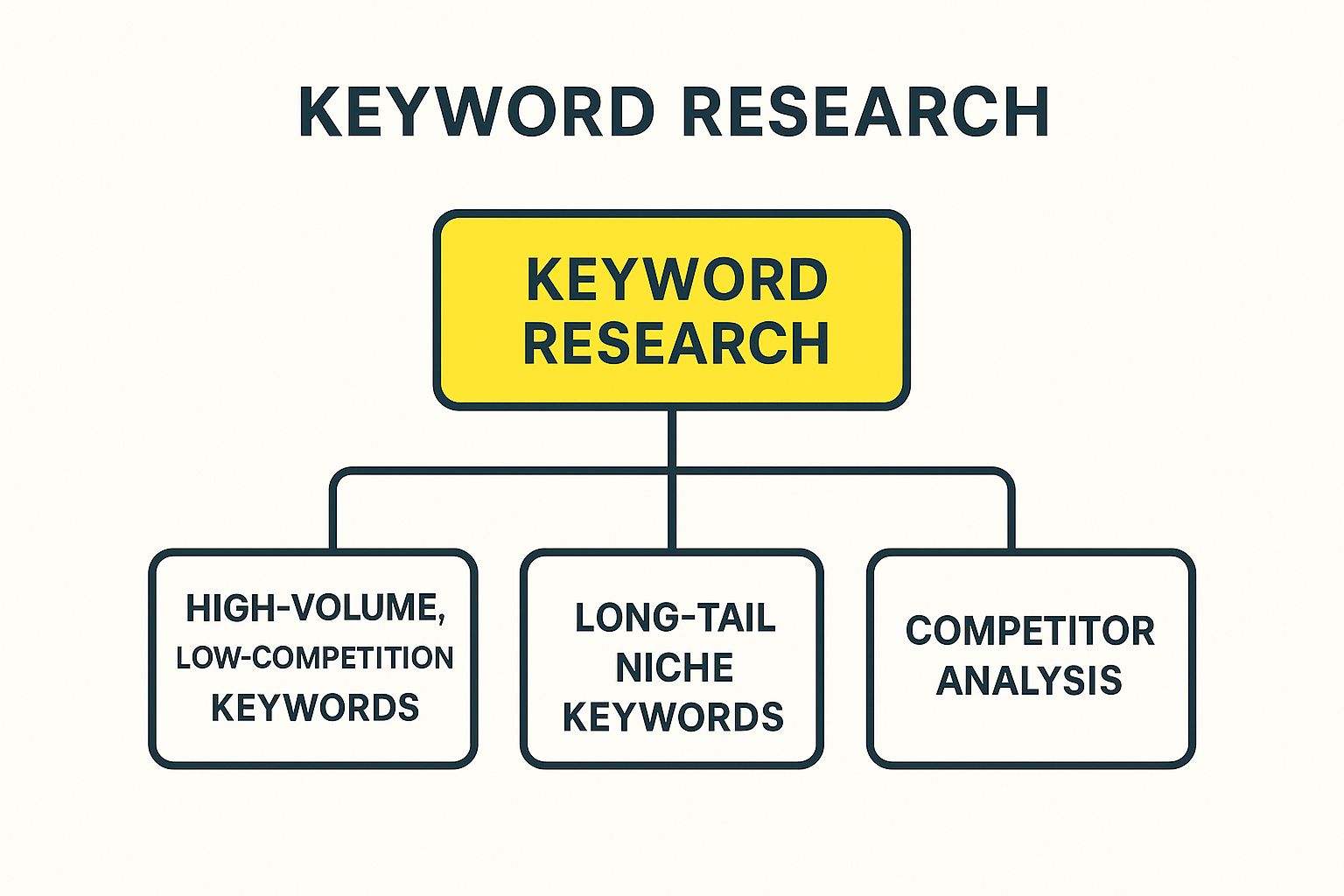
The infographic visualizes the hierarchical relationship between different keyword types, starting with the broadest category (Head Terms) at the top and narrowing down to more specific long-tail keywords at the bottom. This illustrates how keyword strategy should cover a range of search terms, from general to highly specific, to capture a wider audience and cater to different customer search intents. The broader Head Terms have high search volume but also high competition. As we move down the hierarchy to Body Keywords and then Long-Tail Keywords, the search volume decreases, but the competition also lessens, and the search intent becomes more focused.
Before diving into the specifics of each SEO aspect, it's helpful to have a comprehensive overview of all the key elements involved in optimizing your Shopify store. A well-structured checklist can ensure you don't miss any crucial steps. For a comprehensive guide, check out this Shopify SEO Checklist for 2025: Boost Traffic from Wand Websites.
This approach is essential because it aligns your store with actual customer search behavior. Instead of guessing what terms people might use, keyword research reveals the exact language they use, increasing the likelihood of your products appearing in their search results. Keyword research forms the foundation for all other SEO efforts, guiding content creation, on-page optimization, and even off-page strategies like link building.
Features of Effective Keyword Research:
- Identification of high-volume, low-competition keywords: Finding the sweet spot where significant search volume meets manageable competition.
- Analysis of search intent behind keywords: Understanding why people search for certain terms (informational, navigational, transactional).
- Competitor keyword analysis: Discovering which keywords drive traffic to your competitors' stores.
- Long-tail keyword identification for niche targeting: Focusing on longer, more specific phrases that target a particular segment of your audience.
Pros:
- Creates the foundation for all other SEO efforts.
- Helps align your store with actual customer search behavior.
- Can reveal untapped market opportunities.
- Drives targeted, high-intent traffic.
Cons:
- Time-consuming process requiring regular updates.
- Can lead to keyword stuffing if not implemented naturally.
- Requires ongoing monitoring and adjustment.
Examples of Successful Keyword Implementation:
- MVMT Watches: Improved organic traffic by 41% after refining product titles and descriptions with targeted keywords.
- Gymshark: Strategic use of fitness-related keywords in product descriptions helped establish their market position.
Actionable Tips for Keyword Research and Implementation:
- Use tools like Ahrefs, SEMrush, or Google Keyword Planner for research.
- Include keywords naturally in product titles, descriptions, and alt text. Avoid keyword stuffing.
- Organize keywords by search intent (informational, navigational, transactional).
- Target different keyword types across different page types (category pages vs. product pages). For example, use broader “head terms” on category pages and more specific long-tail keywords on individual product pages.
Keyword research and implementation deserves its place at the top of any Shopify SEO checklist because it directly impacts your store's visibility in search results. By understanding and applying these principles, you can significantly improve your chances of attracting qualified traffic and boosting sales.
2. Optimized Site Architecture and URL Structure
A well-organized site architecture is crucial for any Shopify store aiming to rank higher in search results. It acts as a roadmap for both search engines and users, enabling easy navigation and content discovery. This involves creating a logical hierarchy of pages, using clean and descriptive URLs, and ensuring that any page on your site is accessible within just a few clicks from the homepage. This is a key component of any robust Shopify SEO checklist.
A streamlined site structure benefits your Shopify store on multiple levels. For search engines, it facilitates crawling and indexing, allowing them to understand the relationships between different pages and the overall context of your site. This, in turn, helps boost your rankings for relevant keywords. For users, it provides a seamless and intuitive browsing experience, leading to increased engagement, lower bounce rates, and ultimately, higher conversions.
Features of a well-optimized site architecture:
- Logical navigation hierarchy: Organize your pages in a hierarchical structure that mirrors the relationships between your products and categories.
- Clean, readable URLs: Use short, descriptive URLs that include relevant keywords and accurately reflect the page content.
- Effective internal linking: Connect related pages within your site using relevant anchor text. This distributes link equity and helps users discover more relevant content.
- Organized collections and product categorization: Group similar products into logical collections to enhance browsing and filtering options for your customers.
Pros:
- Improves search engine crawlability and indexation, boosting your Shopify SEO.
- Enhances user experience and reduces bounce rates, leading to higher conversions.
- Distributes page authority throughout the site, improving overall ranking potential.
- Makes inventory management more efficient.
Cons:
- Restructuring an established site can cause temporary ranking fluctuations.
- Shopify has some URL structure limitations.
- Requires strategic planning before implementation.
Examples: Successful brands like Allbirds utilize a simple product category structure that makes navigation intuitive for both users and search engines. Similarly, Beardbrand implements clean URLs with descriptive keywords, clearly indicating page content and contributing to their strong SEO performance.
Actionable Tips for Shopify SEO:
- Create a shallow site structure: Ensure all pages are reachable within 3-4 clicks from the homepage.
- Use descriptive URLs: Include relevant keywords in your URLs (e.g.,
/mens-waterproof-hiking-boots). - Implement a logical collection structure: Group related products to improve user browsing and filtering.
- Add breadcrumbs navigation: Enhance user experience and SEO by showing the user's path within the site.
- Remove
/pages/from URLs: Use Shopify redirects to remove this unnecessary element whenever possible.
Learn more about Optimized Site Architecture and URL Structure
This item deserves a prominent place in any Shopify SEO checklist because it forms the foundation of a successful online store. A well-optimized site architecture directly impacts both search engine visibility and user experience, ultimately driving organic traffic and increasing conversions. For established Shopify merchants, business owners, e-commerce managers, and even Shopify Plus users, focusing on site structure is a non-negotiable aspect of achieving long-term online success.
3. Technical SEO Optimization
Technical SEO is the backbone of a successful Shopify store's search engine optimization (SEO) strategy. It focuses on optimizing your store at the code and server level to improve how search engines like Google crawl, index, and ultimately rank your website. While it might sound complex, understanding the basics of technical SEO and implementing its principles is crucial for driving organic traffic and boosting sales. This deserves a spot on your Shopify SEO checklist because it lays the foundation for all other SEO efforts. Without a technically sound website, your content and keyword strategies won't reach their full potential.
Essentially, technical SEO ensures search engines can easily access and understand your site's content. This includes everything from optimizing your site's speed and mobile responsiveness to implementing structured data and ensuring secure connections. A well-optimized site provides a smooth and efficient experience for both search engine bots and human visitors.
Key Features of Technical SEO for Shopify:
- Site Speed Optimization: Faster loading times improve user experience and search engine rankings.
- Mobile Responsiveness: Ensures your site looks and functions perfectly on all devices.
- Structured Data Implementation (Schema Markup): Helps search engines understand the context of your content, leading to rich snippets and improved visibility.
- HTTPS Security: Secures user data and builds trust with search engines.
- XML Sitemap Configuration: Helps search engines discover and index all your important pages.
- Canonicalization: Prevents duplicate content issues by specifying the preferred version of a page.
Pros of Technical SEO Optimization:
- Improved Crawlability and Indexing: Search engines can easily access and index your site's content.
- Enhanced User Experience: Faster loading times and mobile responsiveness create a positive user experience.
- Reduced Bounce Rates and Increased Conversions: A better user experience leads to lower bounce rates and higher conversion rates.
- Helps Prevent Duplicate Content Issues: Canonical tags ensure search engines understand which version of a page is the primary one.
Cons of Technical SEO Optimization:
- Requires Some Technical Knowledge or Developer Assistance: Implementing some technical SEO aspects might require coding knowledge or the help of a developer.
- Some Optimizations May Be Limited by Shopify's Platform Constraints: Shopify's platform has certain limitations that might restrict some advanced technical SEO implementations.
- Can Be Time-Consuming to Implement and Monitor: Technical SEO requires ongoing monitoring and adjustments.
Examples of Successful Implementation:
- Fashion Nova saw a 25% increase in conversion rates after prioritizing page speed optimization and implementing Accelerated Mobile Pages (AMP). This highlights the direct impact of technical SEO on business performance.
- Kylie Cosmetics uses extensive schema markup to enhance product visibility in search results, showcasing how structured data can enrich search listings and attract more clicks.
Actionable Tips for Shopify Merchants:
- Use Google PageSpeed Insights: Identify areas for speed improvement on your website.
- Compress and Optimize All Images: Reduce image file sizes without sacrificing quality to improve loading times.
- Implement Schema Markup for Products: Enable rich snippets in search results, displaying key product information directly on the search engine results page.
- Use the Shopify Bulk Redirect Tool: Fix broken links and redirect old URLs to new ones.
- Regularly Audit Your Site with Tools Like Screaming Frog or Sitebulb: Identify and address technical SEO issues proactively.
Learn more about Technical SEO Optimization to understand how XML sitemaps play a vital role in ensuring your Shopify store is properly indexed. This is particularly valuable for established Shopify merchants, business owners, e-commerce and IT managers, marketing and brand managers, and enterprise clients seeking Shopify Plus solutions who want to maximize their organic reach. By addressing technical SEO comprehensively, you create a robust foundation for achieving higher rankings and increased visibility on search engine results pages (SERPs).
4. Content Strategy and Blog Optimization
A crucial element of any successful Shopify SEO checklist is a robust content strategy, specifically optimized for your blog. Content strategy and blog optimization work hand-in-hand to establish your store as an authority in your niche, attract potential customers, and ultimately drive sales. This involves creating high-quality, informative content that targets informational keywords relevant to your products and resonates with your target audience throughout their buying journey. This deserves a spot on your Shopify SEO checklist because it addresses a critical aspect of online visibility: attracting customers who are still researching and not yet ready to buy.
This approach goes beyond simply optimizing product pages. While product pages focus on converting ready-to-buy customers, your blog content targets users higher up in the sales funnel. It draws in potential customers who are searching for information related to your products, even before they're ready to make a purchase. Learn more about Content Strategy and Blog Optimization
How it Works:
A Shopify SEO checklist item like content strategy relies on creating valuable content around topics relevant to your products. This includes product-related articles, buyer's guides, comparison posts, and industry news and trend coverage. By naturally incorporating relevant keywords within this content, you attract organic traffic from search engines like Google. This targeted traffic consists of potential customers actively seeking information, making them more likely to engage with your brand and eventually convert into paying customers.
Features of a Strong Blog Content Strategy:
- Targeted blog content calendar: Planning your content in advance ensures consistent publishing and allows you to align content with seasonal trends and marketing campaigns.
- Product-related educational content: Articles explaining the benefits and uses of your products establish your expertise and build trust with potential customers.
- Buyer's guides and comparison posts: Help customers navigate their purchasing decisions and position your products as the ideal solution.
- Industry news and trend coverage: Demonstrates your awareness of the latest developments in your industry and positions you as a thought leader.
- SEO-optimized blog structure: Utilizing proper headers (H1, H2, H3) containing relevant keywords, internal links to product pages, and optimized meta descriptions ensures your blog content is easily discoverable by search engines.
Pros:
- Targets top-of-funnel traffic: Captures potential customers that product pages often miss.
- Builds authority and trust: Establishes your brand as a reliable source of information.
- Creates opportunities for natural backlinks: High-quality content naturally attracts links from other websites, further boosting your SEO.
- Increases time-on-site metrics: Engaging content keeps visitors on your website longer, signaling to search engines that your site is valuable.
Cons:
- Requires consistent content creation: Maintaining a blog requires ongoing effort and resources.
- ROI can take time to materialize: Building organic traffic through content marketing is a long-term strategy.
- Needs regular updating: Content needs to be refreshed periodically to maintain relevance and freshness signals for search engines.
Examples of Successful Implementation:
- Beardbrand: Their extensive beard care guides rank for thousands of informational keywords, establishing them as a leading authority in men's grooming.
- Gymshark: Their fitness content blog drives significant traffic that converts to product sales, demonstrating the power of targeted content marketing.
- Solo Stove: Their fire pit guides and recipes bring in potential customers searching for outdoor cooking information, connecting their content directly to their product niche.
Actionable Tips for Shopify Merchants:
- Create content clusters around main product categories to build topical authority.
- Optimize blog posts with proper headers (H1, H2, H3) containing relevant keywords.
- Include internal links to relevant product pages within your blog content to guide users towards conversions.
- Update old content regularly to maintain freshness signals and improve search rankings.
- Incorporate video and visual content to increase engagement and time-on-site.
When and Why to Use This Approach:
Content strategy and blog optimization are essential for any Shopify merchant looking to build a sustainable online presence and attract organic traffic. This approach is particularly valuable for businesses with complex products or services that require education and explanation. It's a long-term investment that pays off by establishing your brand as a trusted authority, driving targeted traffic, and ultimately increasing sales. This item is a vital component of any comprehensive shopify seo checklist. Popularized by industry leaders like Neil Patel, Brian Dean, and HubSpot, content marketing provides a proven framework for long-term online success.
5. Product Page SEO Optimization
Product page SEO optimization is the bedrock of any successful Shopify store. These pages are where the magic happens: browsers become buyers. By optimizing your product pages for search engines, you're not just making them easier to find – you're actively driving targeted traffic that's ready to convert. This means crafting compelling product titles, descriptions, and image alt text, as well as implementing technical elements like schema markup, all while keeping the user experience front and center. This crucial aspect of a Shopify SEO checklist deserves special attention due to its direct impact on your bottom line.
This optimization process hinges on several key features: keyword-rich product titles that accurately reflect the product and user search intent; unique and detailed product descriptions that highlight benefits and answer potential questions; optimized image alt text and filenames that both improve accessibility and contribute to search rankings; product schema markup that enhances search results with rich snippets; and integration of customer reviews for social proof and fresh content.
Why Product Page SEO Matters in Your Shopify SEO Checklist:
For established Shopify merchants, business owners, e-commerce managers, and marketing professionals, product page SEO is the lifeblood of online sales. It directly impacts conversion rates by presenting relevant information to potential customers at the precise moment they're searching for it. Optimizing these pages minimizes duplicate content issues, a common pitfall for e-commerce sites, while simultaneously improving visibility in product-specific searches. Furthermore, detailed product information enhances the user experience, leading to higher customer satisfaction and potentially increased sales.
Examples of Success:
- Allbirds: They utilize benefit-focused, keyword-rich product descriptions that rank well for specific shoe attributes like "sustainable sneakers" or "wool runners."
- Death Wish Coffee: Their product pages effectively target and rank for specific coffee strength-related terms like "strongest coffee" due to their detailed and compelling descriptions.
Pros:
- Directly impacts conversion rates
- Reduces duplicate content issues
- Improves visibility in product searches
- Enhances user experience through detailed information
Cons:
- Time-consuming to optimize at scale
- Requires ongoing maintenance as products change
- Can be challenging to make each description unique for similar products
Actionable Tips for Your Shopify SEO Checklist:
- Keyword Integration: Include primary keywords in product titles naturally, avoiding keyword stuffing.
- Compelling Descriptions: Write 300+ word unique descriptions for each product, focusing on benefits and features. Utilize bullet points to highlight key selling points.
- Image Optimization: Optimize all product images with descriptive filenames and alt text, ensuring accessibility and search relevance.
- Schema Markup: Implement product schema markup to enable rich results in search engine listings, providing more information directly in search results.
- FAQ Integration: Include FAQ sections on product pages to target additional long-tail keywords and answer common customer questions, improving user experience and providing valuable content.
- Customer Reviews: Enable and encourage customer reviews to generate fresh content, build trust, and provide valuable social proof.
By prioritizing product page SEO in your Shopify SEO checklist, you are investing in a strategy that directly translates to improved search visibility, increased conversion rates, and ultimately, a more successful online business.
6. Meta Tag and Title Tag Optimization
Meta tag and title tag optimization is a crucial aspect of any successful Shopify SEO checklist. These HTML elements act as a bridge between your shop's content and search engines, playing a significant role in both search visibility and click-through rates (CTR). By optimizing these tags, you're essentially telling search engines what your page is about and enticing potential customers to click through from search results to your Shopify store. This relatively simple optimization can yield substantial improvements in your organic search performance.
How Meta Tags and Title Tags Work
Search engines use title tags as the primary headline for a page in search results. They are a major ranking factor and directly influence whether someone clicks on your listing. Meta descriptions, another type of meta tag, appear below the title tag in search results. While not a direct ranking factor, a compelling meta description can significantly improve CTR. Open Graph tags, also meta tags, control how your pages appear when shared on social media platforms. Finally, proper heading tag hierarchy (H1-H6) within your page content helps search engines understand the structure and importance of information on your pages.
Why This is Essential for Your Shopify SEO Checklist
This item deserves a prominent place on your Shopify SEO checklist because it’s a fundamental element of on-page SEO. It’s a relatively low-effort, high-impact activity that can significantly improve your search visibility and drive qualified traffic. Without optimized meta tags and title tags, you're essentially leaving potential traffic on the table.
Features and Benefits
- Unique, keyword-rich title tags: Improve search ranking for relevant keywords and clearly communicate page content to users.
- Compelling meta descriptions: Entice users to click through from search results with persuasive language and calls to action.
- Open Graph tags for social sharing: Optimize the appearance of your pages when shared on social media, driving more traffic from social channels.
- Proper heading tag hierarchy: Improve content structure and readability for both users and search engines.
Pros:
- Directly influences click-through rates from search results.
- Helps search engines understand page content.
- Relatively easy to implement.
- Can significantly improve rankings with minimal effort.
Cons:
- Google may rewrite meta descriptions if it deems them irrelevant or inaccurate.
- Character limitations restrict messaging.
- Requires regular auditing and updates to maintain optimal performance.
Examples of Successful Implementation:
- Pura Vida Bracelets: Saw a 12% increase in organic CTR after optimizing meta descriptions with emotional triggers. This shows the power of crafting compelling copy that resonates with your target audience.
- ThirdLove: Uses benefit-focused title tags that achieve high CTRs for competitive keywords. By highlighting the value proposition directly in the title tag, they attract more clicks.
Actionable Tips for Shopify Merchants:
- Keep title tags concise: Aim for under 60 characters to prevent truncation in search results.
- Craft compelling meta descriptions: Write descriptions between 120-158 characters, incorporating relevant keywords and persuasive language.
- Prioritize primary keywords: Include your most important keywords near the beginning of your title tags for maximum impact.
- Include calls to action: Encourage clicks with phrases like "Shop now," "Discover," or "Learn more" in your meta descriptions.
- Highlight value: Include price points or promotions in meta descriptions when relevant to attract bargain hunters.
- Ensure uniqueness: Every page on your Shopify store should have a unique title tag and meta description.
- Regularly audit and update: Search engine algorithms and user behavior change over time, so make sure to review and update your meta tags and title tags periodically.
By following these tips and incorporating meta tag and title tag optimization into your Shopify SEO checklist, you can significantly improve your online visibility, attract more qualified traffic, and ultimately boost your bottom line.
7. Link Building and Off-Page SEO
Link building is a crucial aspect of any successful Shopify SEO checklist, and it's essential for long-term, sustainable growth. It falls under the umbrella of off-page SEO, encompassing activities performed outside your Shopify store to improve your search engine rankings. Essentially, link building involves acquiring high-quality backlinks from relevant websites to boost your domain authority and improve your visibility in search results. This strategy signals to search engines like Google that your store is a trustworthy and authoritative source within your niche. A robust link building profile is like a vote of confidence from other websites, telling Google, "This store offers valuable content and products." This, in turn, improves your organic search rankings, driving more targeted traffic to your Shopify store.
How it Works:
Search engines use complex algorithms to determine which websites deserve to rank highly for specific keywords. Backlinks are a significant ranking factor. When a reputable website links to yours, it's like a recommendation. The more high-quality backlinks you have, the more authoritative your store appears to search engines. This translates into higher rankings and increased organic visibility.
Features of Effective Link Building:
- Quality Backlink Acquisition: Focus on obtaining links from websites with high domain authority and relevance to your niche. A link from a respected industry blog is far more valuable than a link from a low-quality directory.
- Influencer Collaborations: Partnering with influencers in your niche can provide valuable backlink opportunities and expose your brand to a wider audience.
- Guest Posting Opportunities: Contributing high-quality content to other blogs in your industry can earn you valuable backlinks and establish you as an expert in your field.
- Digital PR for Brand Mentions: Actively pursuing PR opportunities can lead to brand mentions and backlinks from authoritative news websites and publications.
- Social Signals and Engagement: While not direct ranking factors, social signals like shares and comments can indirectly influence your SEO by increasing brand visibility and attracting potential link opportunities.
Pros:
- Builds Domain Authority and Trust Signals: High-quality backlinks boost your store's authority in the eyes of search engines, improving your overall ranking potential.
- Drives Referral Traffic Alongside SEO Benefits: Backlinks not only improve your SEO but also drive direct referral traffic to your store.
- Creates Brand Awareness in Target Markets: Link building helps increase brand visibility and reach within your specific niche.
- Can Provide Competitive Advantage in Crowded Niches: A strong backlink profile can set you apart from competitors in highly competitive markets.
Cons:
- Time-intensive with Uncertain Results: Building high-quality backlinks takes time and effort, and there's no guarantee of immediate results.
- Quality Links are Increasingly Difficult to Acquire: Earning valuable backlinks requires strategic outreach and content creation.
- Poor Link Building Can Result in Penalties: Engaging in black hat link building tactics can result in penalties from search engines, harming your rankings.
- Requires Ongoing Relationship Building: Effective link building involves nurturing relationships with other website owners and influencers.
Examples of Successful Implementation:
- MVMT Watches: Built initial SEO success through strategic partnerships with fashion bloggers and influencers, generating valuable backlinks and brand exposure.
- Beardbrand: Gained powerful backlinks through founder Eric Bandholz's guest appearances on relevant industry podcasts and strategic content marketing.
Actionable Tips for Shopify Merchants:
- Create Linkable Assets: Develop high-quality content like original research, infographics, or tools that other websites will want to link to.
- Reach Out to Product Review Blogs in Your Niche: Offer free products for review in exchange for a backlink to your store.
- Get Listed in Relevant Industry Directories: Ensure your store is listed in reputable online directories related to your industry.
- Develop Relationships with Complementary (Non-competing) Brands for Cross-Promotion: Partner with related businesses to exchange backlinks and expand your reach.
- Leverage PR for Product Launches and Company Milestones: Generate media coverage and backlinks by promoting new product releases and company achievements.
- Monitor Brand Mentions and Ask for Link Attribution When Mentioned: Use tools to track brand mentions online and request a backlink when your store is mentioned without one.
Why This Item Deserves Its Place in the Checklist:
Link building is a fundamental aspect of long-term Shopify SEO success. It's not a quick fix, but a sustained effort that builds your store's authority and drives organic traffic over time. Ignoring link building is like trying to build a house without a foundation – it might stand for a while, but it won't be stable or sustainable in the long run. For established Shopify merchants, business owners, and marketing managers looking for lasting growth, link building is an absolute necessity. This is particularly true for those operating in competitive niches and those utilizing Shopify Plus, where organic visibility is critical for maximizing ROI.
7-Point Shopify SEO Strategy Comparison
| Strategy / Best Practice | Implementation Complexity 🔄 | Resource Requirements 💡 | Expected Outcomes 📊 | Ideal Use Cases | Key Advantages ⭐ |
|---|---|---|---|---|---|
| Keyword Research and Implementation | Medium 🔄🔄 | Moderate 💡 | High targeted traffic and new market insights 📊📊 | Foundational SEO efforts, content planning | Drives targeted traffic, reveals untapped keywords ⭐⭐ |
| Optimized Site Architecture & URL Structure | Medium-High 🔄🔄🔄 | Moderate to High 💡 | Improved crawlability, UX, and page authority 📊 | Stores needing better navigation and indexing | Enhances SEO crawl efficiency, improves UX ⭐⭐ |
| Technical SEO Optimization | High 🔄🔄🔄🔄 | High (technical skills + tools) 💡 | Faster site, better indexing, fewer errors 📊 | Sites with performance, security, or crawl issues | Boosts crawlability, conversion rates, and speed ⭐⭐⭐ |
| Content Strategy and Blog Optimization | Medium 🔄🔄 | High (content creation) 💡 | Builds authority, generates top-of-funnel traffic 📊 | Stores focusing on long-term organic growth | Builds trust and backlinks, enhances engagement ⭐⭐ |
| Product Page SEO Optimization | Medium 🔄🔄 | Moderate to High 💡 | Better product visibility and higher conversions 📊 | Product-heavy stores aiming to improve sales | Directly impacts conversions and reduces duplications ⭐⭐ |
| Meta Tag and Title Tag Optimization | Low 🔄 | Low 💡 | Increased CTR, better rankings 📊 | Quick wins for all pages | Easy to implement, improves CTR and relevancy ⭐ |
| Link Building and Off-Page SEO | High 🔄🔄🔄 | High (outreach, PR) 💡 | Higher domain authority, referral traffic 📊 | Established stores aiming for authority and trust | Builds authority and referral traffic, boosts rankings ⭐⭐ |
Dominate Search Results: Your Shopify SEO Journey Starts Now
This Shopify SEO checklist has covered the essential elements for optimizing your online store, from keyword research and technical SEO to content strategy and link building. Mastering these core concepts is crucial for increasing your visibility on search engines, driving organic traffic to your product pages, and ultimately, boosting your sales and revenue. Remember, the most important takeaways are consistent implementation and ongoing monitoring. By focusing on providing a user-friendly experience while adhering to SEO best practices, you'll create a powerful foundation for sustainable growth and a dominant online presence.
Implementing these strategies takes time and effort, but the rewards are substantial: increased organic visibility, higher conversion rates, and a more profitable online business. Ready to take your Shopify store to the next level? E-commerce Dev Group, a leading Shopify partner, specializes in helping businesses like yours implement effective SEO strategies and maximize organic performance. Visit E-commerce Dev Group today to learn how we can help you climb the search rankings and achieve your e-commerce goals.
