


Unlocking the Power of Shopify B2B Ecommerce
Moving from traditional wholesale to a digital-first model can feel overwhelming. Fortunately, Shopify’s B2B channel brings company accounts and automated approval workflows into one platform. Merchants also report fewer order errors and reduced manual touchpoints, freeing teams to focus on growth rather than paperwork.
This section explores those capabilities, presents performance data in a data chart, and compares plan features to help you choose the right setup.
Core B2B Ecommerce Features On Shopify
Shopify offers features designed for business buyers:
- Company Profiles with granular user permissions for all stakeholders
- Custom Pricing and volume-based discounts per account
- Order Approval Workflows that send high-value orders to your sales team
- Bulk Order Forms and quick reordering based on past purchases
- Inventory Visibility across warehouses to cut stockouts
- App Integrations with ERP, CRM, and accounting systems for synced data
These building blocks support a self-serve wholesale experience that feels as smooth as B2C shopping.
Data Chart: Shopify B2B GMV Growth
The data chart below visualizes Shopify’s year-over-year B2B gross merchandise value (GMV) growth in Q4.
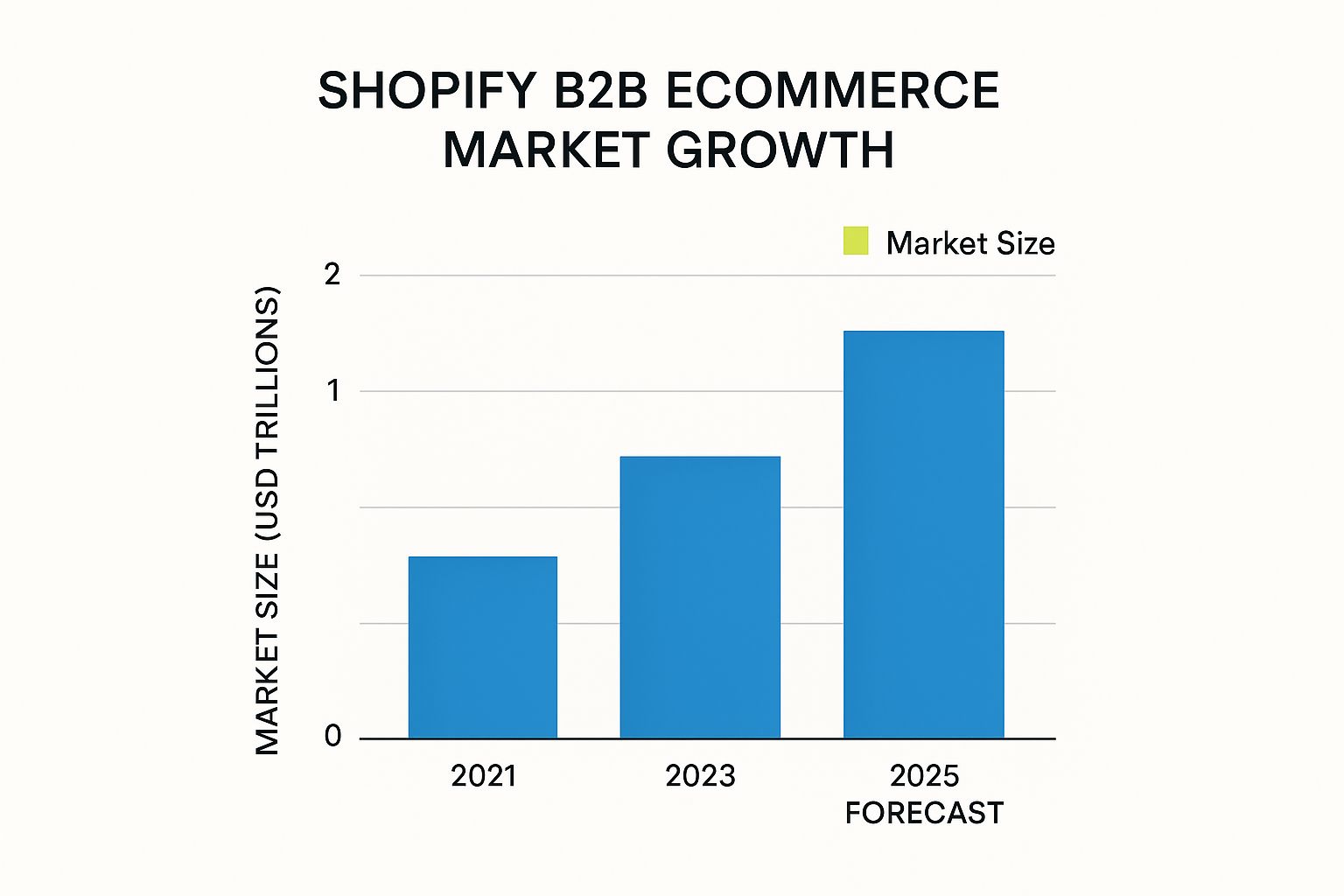
From the chart, you can see a 132% increase in GMV in Q4 2023 and a clear November peak, pointing to rising wholesale demand.
The global B2B ecommerce market is on track to reach $36 trillion by 2026.
Shopify B2B Ecommerce Features Comparison
Shopify B2B Ecommerce Features Comparison
A comparison of key features available across different Shopify plans for B2B ecommerce
| Feature | Shopify Basic | Shopify | Advanced Shopify | Shopify Plus |
|---|---|---|---|---|
| Company Accounts | ✔ | ✔ | ✔ | ✔✔ |
| Custom Pricing | ✖ | ✔ | ✔ | ✔✔ |
| Approval Workflows | ✖ | ✖ | ✔ | ✔✔ |
| Bulk Order Forms | ✔ | ✔ | ✔ | ✔✔ |
| Inventory Visibility | ✔ | ✔ | ✔ | ✔✔ |
| ERP/CRM Integrations | Basic | Standard | Advanced | Enterprise |
| Shopify Flow Automations | ✖ | ✖ | ✖ | ✔✔ |
This table shows that Shopify Plus unlocks the fullest B2B toolkit—perfect for complex approvals and heavy automation—while Advanced Shopify meets the needs of growing wholesalers who require extra control.
With a clear view of features, growth trends, and plan options, you’re ready to build a B2B storefront that delivers both efficiency and the tailored experiences your customers expect. Discover more insights about Shopify’s B2B growth here.
Building Your Shopify B2B Store That Actually Converts

Choosing the right Shopify plan sets the foundation for a high-converting wholesale channel. For example, Advanced Shopify lets you offer custom pricing and automated approval flows, while Shopify Plus unlocks enterprise automations with Shopify Flow. This means you can grow from a few accounts to hundreds without rebuilding your storefront.
With your plan in place, the next step is to enable the features B2B buyers expect. Let’s look at the key settings you’ll want to configure first.
Configure Essential Store Settings
Start by creating company profiles and assigning user permissions that match your sales process. A password-protected storefront keeps your pricing private and prompts high-value prospects to register.
Key setup tasks include:
- Defining user roles (ordering only vs. admin)
- Restricting product visibility by customer group
- Enforcing minimum order quantities through checkout rules
Once these essentials are live, turn your attention to catalog design for a smoother buying experience.
Design Intuitive B2B Catalogs
A large wholesale catalog can overwhelm buyers. By grouping products into clear collections and adding filters for SKU, warehouse location, and past orders, you cut friction and speed up the search.
| Approach | Benefit | Drawback |
|---|---|---|
| Large Single Catalog | Easier to maintain | Harder to navigate |
| Customer-Specific Catalog | Personalized experience, faster buy | Requires extra setup per account |
This comparison shows that customer-specific catalogs often deliver a smoother path to purchase. Next, let’s make sure prices match each buyer’s needs.
Implement Customer-Specific Pricing
Use Shopify’s price lists feature to set tailored discounts and net terms. Follow these best practices:
- Creating tiered discounts based on volume
- Automating net 30, 60, or 90 terms per account
- Locking minimum and maximum quantities to protect margins
With pricing configured, it’s time to simplify the checkout process.
Streamline Checkout for B2B Buyers
Procurement teams value speed over flair. To reduce abandoned carts, try these steps:
- Enable invoice generation for ACH and check payments
- Vault credit card details for repeat orders
- Use Shopify Flow to send approval notifications automatically
These changes cut manual work and let customers complete orders in minutes.
Real-World Example: How One Wholesaler Grew Orders by 40%
Acme Fabrics restructured its catalogs and checkout in under a week. By deploying segmented price lists and adding custom filters, they saw a 40% increase in order volume within two months.
You might be interested in: How to Master Shopify B2B Ecommerce Strategies to take your store from pilot to powerhouse.
The Digital Revolution Reshaping B2B Sales On Shopify

The rise of digital-first buying is now the norm for B2B customers. They expect the same ease and speed they get in consumer ecommerce. This means wholesalers need to upgrade how they interact with bulk buyers.
Enterprise customers look for self-service portals, live stock updates, and mobile-friendly stores. These features mirror the convenience of platforms like Amazon. It makes Shopify a key option for B2B sellers.
The portion of B2B revenue generated online has jumped from 32% in 2020 to a forecast 56% by 2025. Companies can’t rely on fax orders or phone calls anymore. Discover more insights about B2B ecommerce trends here
Changing Buyer Expectations
Modern procurement teams want:
- On-Demand Self-Service: Browse, order, and pay without a rep
- Personalized Catalogs: Custom product lists and negotiated rates
- Mobile Ordering: Fast, intuitive mobile interfaces
- Instant Approval Workflows: Automated sign-offs for large orders
Meeting these needs calls for a platform that combines digital speed with a human touch.
Manual Processes Versus Shopify Automation
| Feature | Manual Wholesale | Shopify B2B Automation |
|---|---|---|
| Order Entry | Email or fax forms | Bulk order forms & API sync |
| Pricing Updates | Spreadsheet edits | Dynamic price lists per account |
| Approval Workflows | In-person sign-offs | Automated routing & alerts |
| Inventory Visibility | Phone check-ins | Real-time stock across sites |
Moving from manual steps to automation cuts errors and shortens lead times.
How Shopify Bridges Digital Efficiency And Relationship Service
Shopify’s B2B tools combine speed with support:
- Password-Protected Storefronts for secure pricing
- Company Accounts with permission controls
- Custom Catalogs tied to each client agreement
- Automated Approval Flows for orders over set limits
- Flexible Payment Options: ACH, Net terms, or saved cards
These features help brands offer a consumer-grade experience while keeping personal service.
Case Study Snapshots
A few examples of success on Shopify:
- A specialty parts supplier cut order time by 60% using a self-service catalog.
- A foodservice company boosted repeat orders by 45% with custom pricing and mobile checkout.
- An industrial firm merged 10 portals into one Shopify Plus site, saving over $200K a year.
Strategies To Ride The Digital Wave
To make the most of this shift:
- Audit your buyer journey and remove any friction
- Segment customers by volume, industry, or contract terms
- Use Shopify Analytics and Flow for smart automations
- Connect your ERP and CRM to keep data in sync
This plan lets businesses deliver digital sales experiences that cut costs and build loyalty.
Creating B2B Buyer Experiences That Drive Loyalty

Building loyalty on Shopify B2B Ecommerce is more than offering bulk discounts. When merchants present the right products to the right buyers, average order value rises and repeat rates improve. To achieve this, focus on personalized catalogs, clear navigation, and tools that let customers handle orders without calls or emails.
Implement Client-Specific Product Catalogs
Personal catalogs cut decision time and prevent mistakes. For example, Acme Electronics created separate collections for resellers and integrators, reducing order processing by 30%. Key benefits include:
- Tailored product lists that match agreed pricing
- Dynamic collections driven by customer tags or contract terms
- Exclusive deals hidden from general visitors
- Automated catalog updates based on inventory levels
These steps help buyers make faster, more confident choices.
Stream Self-Service Account Management
B2B buyers want control. In fact, 65% expect a portal where they can track orders, download compliance documents, and reorder instantly. A dashboard can offer:
- Saved orders and one-click reorders
- Access to invoices, delivery notes, and net-term statements
- A library of technical specs and certifications
- Permission-based roles for teams
- Inline messaging for quick support
Moving these tasks online lets your sales team focus on strategic conversations.
Optimize Navigation for Complex Product Lines
When your catalog has thousands of SKUs, intuitive filters are essential. RetailCo added search by SKU, past orders, and warehouse location, leading to a 25% drop in abandoned searches. Best practices include:
- Faceted filters for specs, brand, and contract status
- Auto-complete tied to a buyer’s history
- Quick links to recent and frequent orders
- Mobile-friendly menus that cut scroll fatigue
Clear inventory paths mean customers spend less time hunting and more time buying.
B2B Buyer Experience Optimization Strategies
Key strategies for enhancing different aspects of the B2B customer journey on Shopify
| Experience Touchpoint | Common Challenges | Optimization Strategy | Expected Impact |
|---|---|---|---|
| Catalog Personalization | Overwhelming product lists | Client-specific collections per account | 30% faster order placement |
| Navigation | Difficulty finding products | Dynamic filters by SKU, past orders | 25% drop in search bounce |
| Account Management | Manual invoice requests | Self-service invoice and document hub | 40% fewer support tickets |
| Compliance Documentation | Delayed approvals | Integrated spec sheets and certifications | 50% shorter approval cycle |
| Mobile Ordering | Poor phone interface | Mobile-optimized B2B themes | 35% increase in mobile orders |
This table shows how targeted enhancements at each touchpoint can speed up orders, cut support tickets, and boost mobile sales.
You might be interested in: How to Master Shopify B2B Ecommerce Strategies for deeper tips on catalog setup and approval workflows.
By combining client-specific catalogs, self-service account management, and intuitive navigation, Shopify merchants create buying journeys that respect time and build loyalty. Next, we’ll explore how to connect these experiences with your core business systems.
Connecting Shopify B2B With Your Business Ecosystem
Disparate systems can create bottlenecks that slow growth and cause costly mistakes. By linking your Shopify B2B ecommerce storefront with core business tools, you turn isolated data sets into a single source of information. For example, real-time inventory updates from an ERP can cut stockouts by 25%, while synced records in your CRM speed up follow-up calls. Teams then spend less time on duplicate entry and more on planning and analysis.
Integration Approaches
Businesses often choose one of three ways to connect Shopify B2B with ERP platforms, inventory systems, CRMs, and accounting software:
| Approach | Complexity | Cost | Implementation Time | Ideal For |
|---|---|---|---|---|
| Native Connections | Low | $$ | Days | Standard ERPs and CRMs |
| Middleware Tools | Medium | $$$ | 2–4 Weeks | Multi-system environments |
| Custom Development | High | $$$$ | 2–4 Months | Unique workflows and mappings |
Native connections launch quickly but may lack customization. Middleware tools like Zapier or MuleSoft offer pre-built links with moderate flexibility. Custom development provides exact control but requires more time and budget.
Best Practices For Data Synchronization
Once you pick an approach, use these tips to keep data flowing smoothly:
- Define a single source of truth for each data type (products, customers, orders).
- Map fields across systems to prevent mismatches (e.g., SKU in Shopify vs. part number in ERP).
- Schedule updates during off-peak hours to limit performance impact.
- Set up automated alerts for sync failures and reconciliation checks.
Following these steps reduces errors and keeps order data accurate.
Overcoming Common Integration Challenges
Even with a plan, you may hit API limits or face different data formats. Treat these as setup steps rather than obstacles. For example:
- Use batch processing to work around API quotas
- Let middleware normalize data into a shared structure
- Run end-to-end tests before go-live and monitor feeds to catch issues early
With systems tied together, your Shopify B2B ecommerce operations become more stable and ready to scale. Up next, we’ll look at B2B marketing strategies that turn these efficiencies into steady order growth.
B2B Marketing Strategies That Actually Generate Orders
When typical consumer tactics fall short, B2B marketing calls for a sharper focus and patience. A 2023 DemandGen study shows that 72% of B2B buyers respond best to personalized outreach. This means moving away from broad campaigns toward data-driven messages that resonate with procurement teams and decision-makers.
Targeted Account-Based Marketing
Account-Based Marketing (ABM) brings sales and marketing teams together around a select list of high-value accounts. Instead of casting a wide net, you zero in on companies that match your ideal customer profile. Key steps include:
- Identifying accounts by revenue potential and industry
- Mapping decision-makers and their purchasing criteria
- Crafting custom proposals and outreach sequences
- Aligning with sales reps for real-time feedback
By using CRM data to personalize messages, you can lift conversion rates by up to 40%. Main takeaway: ABM builds trust and sets the stage for long-term relationships.
Content That Addresses Industry Pain Points
Educational content helps you stand out and attract business buyers. Generic posts won’t cut it—you need assets that solve real problems:
- In-depth white papers on compliance or logistics challenges
- Case studies featuring shopify b2b ecommerce success stories
- Interactive ROI calculators to show savings from automation
- Webinars led by experts on negotiation and net terms
When your content addresses specific pain points, buyers see you as a partner rather than just a vendor. As they engage, you can segment them for precise follow-up.
Lead Nurturing Campaigns and Metrics
Strong lead nurturing respects the longer B2B sales cycle of 3–9 months. Use automated drip emails and retargeting ads to stay top of mind. Combine content offers with brief surveys to gauge interest.
Use the table below to compare common channels:
| Channel | Typical Response Rate | Ideal Use Case |
|---|---|---|
| Email Drip Series | 18% | Educational nurturing |
| Retargeting Ads | 12% | Abandoned demo requests |
| LinkedIn Outreach | 9% | Executive-level engagement |
| Webinars | 25% | Thought leadership |
Be sure to track marketing-sourced pipeline and cost per opportunity. These metrics show which tactics are really driving orders.
Check out our guide on How to Master Shopify B2B Ecommerce Marketing to refine these strategies and turn engagement into revenue.
Scaling Your Shopify B2B Operation For Sustainable Growth
Expanding your wholesale channel beyond the initial setup calls for a clear blueprint. You need to boost revenue without overloading your teams or harming service levels. By treating your store as an interconnected system—where customer segmentation, pricing, fulfillment workflows, and analytics all inform each other—you make sure each new account adds value.
Effective Customer Segmentation
Segmenting buyers sharpens sales focus and lifts average orders. For instance, a regional parts supplier divides customers by industry and order size. You can group buyers by:
- Volume Tiers (Small, Mid-Market, Enterprise)
- Geographic Regions (North America, EMEA, APAC)
- Industry Verticals (Construction, Hospitality, Retail)
- Lifetime Value Brackets (New, Returning, VIP)
This setup paves the way for flexible pricing models that safeguard your margins.
Tiered Pricing Structures
When pricing reflects how customers buy, you reward loyalty without squeezing profits. Offer volume-based discounts, membership perks for repeat orders, and custom rates for high-value accounts.
| Tier | Discount Rate | Minimum Order Value | Key Benefit |
|---|---|---|---|
| Standard | 0% – 5% | $500 | Entry-level public pricing |
| Volume | 6% – 15% | $2,000 | Encourages larger, predictable orders |
| Enterprise | 16% – 25% | $10,000 | Custom terms and dedicated support |
Main takeaway: Tiered pricing protects margins and ties directly back to your segmentation strategy.
Optimizing Fulfillment Workflows
Manual packing and shipping can slow you down as orders grow. To keep operations reliable:
- Use automated pick-and-pack instructions with barcode scanners
- Partner with 3PL providers for overflow handling
- Sync inventory in real time across warehouses
- Apply zone-based shipping rules to control costs
A bulk textile distributor cut shipping errors by 30% after linking an automated label-printing routine to Shopify’s API. These steps free your team to focus on customer care.
Using Analytics To Drive Growth
Ongoing growth depends on spotting trends early. Shopify’s built-in analytics let you:
- Compare performance across customer segments and price tiers
- Spot underperforming SKUs for targeted promotions
- Track regional demand shifts to guide expansion
- Monitor repeat-order cycles to refine net-term policies
Review these metrics weekly to uncover 10–20% growth opportunities—for example, promoting a winter-best accessory in colder regions.
Ready to put these strategies into action? Partner with E-commerce Dev Group, your Shopify design and development specialists, to build and scale a Shopify B2B eCommerce operation built for sustainable growth. Start scaling today
